

The reference design enables accurate low-side current sensing for automotive and industrial equipment using a shunt resistor and a low-noise operational amplifier.
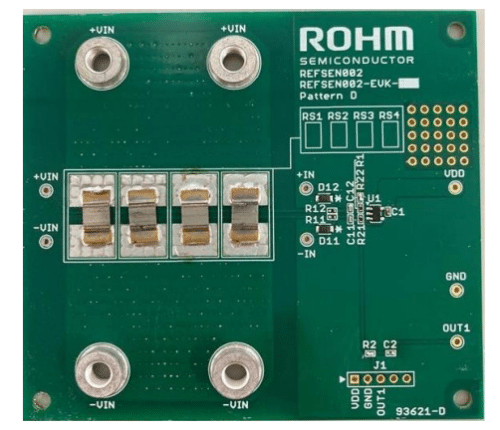
ROHM Semiconductor has unveiled a reference board for low-side current sensing to simplify current measurements in automotive and industrial equipment applications. The board uses a shunt resistor and a low-offset operational amplifier to enable accurate current sensing. Additionally, it also includes design resources that help engineers reduce development time.
The reference board implements low-side current sensing using a shunt-resistor technique and the low-noise complementary metal-oxide-semiconductor (CMOS) operational amplifier. The board operates from a supply voltage of 2.7V to 5.5V, supports sense-line voltages of up to 26V with Zener diode protection, and has an analogue voltage output proportional to the sensed current. It can measure currents of up to 100A.
In order to provide accurate high-current sensing, the circuit employs four 2mΩ shunt resistors, which are connected in parallel with the op-amp and supporting passive elements. The PCB also uses Zener diodes to protect the inputs from voltage spikes. Measuring 90mm x 80mm, the four-layer PCB design supports reliable high-current operation while preserving signal integrity.
The reference design circuit board includes a simple evaluation procedure for testing the performance of the circuit with the help of direct current (DC) power supply, voltmeter and device under test (DUT). It is possible to perform current sensing tests using the currents of up to 100A and measuring the output voltage. The documentation also includes measurement circuits provided for the circuit with DC sweep, transient and alternating current (AC) analysis.
Thermal performance is one aspect that has been considered by ROHM in its reference design. The maximum shunt resistor terminal temperature reaches approximately 70°C when the current being detected is 100A and the ambient temperature is 25°C. The documentation also explains the derating of power and operating temperature. Design files and application notes help engineers to customise the reference design for different current sensing applications.
For more information, click here.