This reference design converts AC power into a -12V supply using fewer parts, while offering low power use, built-in protection and a small board size.
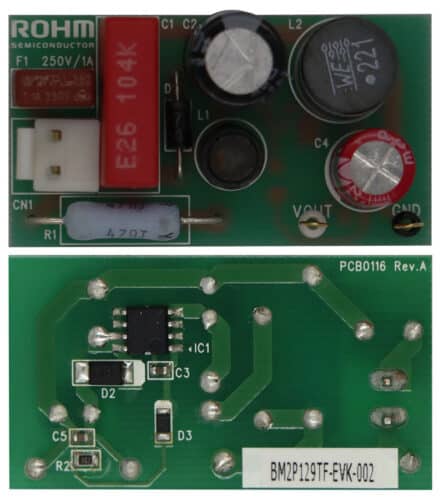
Many industrial and embedded systems require a low-power negative voltage rail to operate analog circuits, sensors, amplifiers and control electronics. Designing such a supply directly from the AC mains often increases component count and PCB area. The REFACDC009 reference design from ROHM demonstrates a compact approach to generating a regulated -12V output from a universal AC input.
The design accepts an input voltage from 90VAC to 264VAC at 47Hz to 63Hz and delivers a regulated -12V output with a maximum power of 2W. It can supply up to 167mA of output current, making it suitable for low-power industrial, measurement and control applications. The design achieves a typical efficiency of about 72.2%, while standby power consumption is only 44mW. Output ripple is specified at 29mV peak-to-peak, excluding switching spikes.
A key feature of the design is the use of a power conversion IC that integrates the high-voltage switching device, startup circuitry and current sensing into a single package. This reduces the number of external components, simplifies PCB routing and enables a smaller power supply. The complete evaluation board measures only 25mm × 45mm, making it suitable for space-constrained equipment. The compact layout also shortens current paths, helping reduce parasitic effects that can affect switching performance and converter stability.
The converter operates using pulse-width modulation (PWM) current-mode control with a fixed switching frequency of 100kHz. Current-mode control improves load response by monitoring the inductor current during every switching cycle while simplifying control loop compensation. Under light-load conditions, the controller automatically lowers the switching frequency to reduce switching losses. A built-in frequency-hopping function spreads switching energy across a wider frequency range, helping lower electromagnetic interference without additional filtering components. This allows the converter to operate across a wide input voltage range while keeping power losses under control.

The design also incorporates a high-voltage fast recovery diode to reduce switching losses. Several protection features are integrated into the controller, including soft start, cycle-by-cycle overcurrent protection, undervoltage protection and overvoltage protection. Soft start limits inrush current during power-up, while the protection circuits safeguard both the power supply and the connected load during abnormal operating conditions.
Design engineers can use this reference design as a starting point for developing compact offline power supplies that require a negative voltage rail. It can be adapted for instrumentation, industrial controllers, sensor interfaces and other embedded equipment by modifying component values to suit different output requirements. The available design files also help speed up prototyping, verification and customisation, reducing development time before moving to production.
ROHM has tested this reference design. It comes with a bill of materials (BOM), schematics, assembly drawing, printed circuit board (PCB) layout, and more. The company’s website has additional data about the reference design. To read more about this reference design, click here.