

A complete system-level reference design enabling dual-motor control, advanced inverter technology, and optimized power conversion for modern, energy-efficient air conditioner outdoor units.
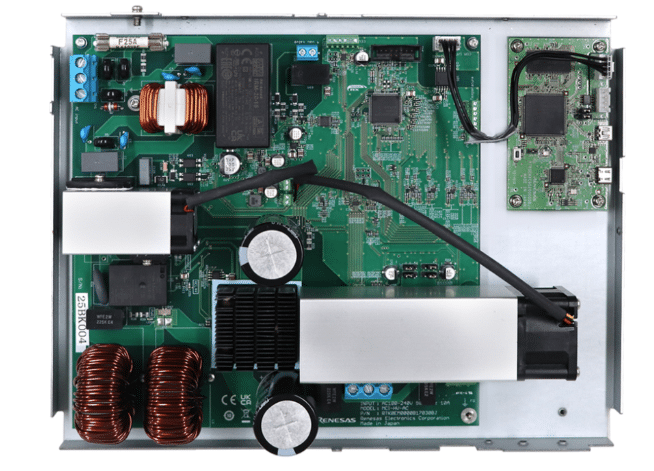
The Renesas AIR-CON-ODU-REF reference design is a comprehensive, system-level solution that accelerates the development of inverter-driven outdoor units (ODUs) for air conditioners. It provides a ready-to-evaluate hardware and software platform that integrates power electronics, motor control, and system interfaces into a unified architecture. Built around the RX26T microcontroller and a high-voltage inverter board, the design enables engineers to prototype and validate dual-motor control strategies for both the compressor and condenser fan within a single embedded control framework.
From a design engineering perspective, this reference platform demonstrates how to implement efficient variable-speed motor control using permanent magnet synchronous motors (PMSM) with sensorless vector control algorithms.The system employs open-loop starting techniques at low speeds and transitions to observer-based control at medium and high speeds, ensuring stable operation across the entire speed range. Advanced control features such as maximum torque per ampere (MTPA), flux weakening for high-speed operation, and torque ripple suppression are included to optimize efficiency and dynamic response. These capabilities are critical in HVAC systems where energy efficiency, acoustic performance, and reliability are key design constraints.
A key highlight of the design is its integrated power stage, which incorporates a three-phase inverter and power factor correction (PFC) circuitry. The platform supports both single-phase and interleaved PFC topologies, enabling high power factor and reduced harmonic distortion when connected to the AC grid. This is particularly important for meeting regulatory requirements and improving overall system efficiency in high-power appliances. The hardware also includes protection mechanisms such as overcurrent, overvoltage, and thermal shutdown, which enhance system robustness and simplify compliance with safety standards.
In addition to motor control and power conversion, the reference design provides a wide range of peripheral interfaces necessary for a complete outdoor unit implementation. These include interfaces for temperature sensors, expansion valves, four-way valves, and communication links to the indoor unit. Such integration allows engineers to evaluate not only the core control algorithms but also the full system-level behaviour, including thermal management and system coordination.
Overall, this reference design serves as a practical blueprint for developing modern inverter-based air conditioning systems. By combining hardware, firmware, and application examples, it reduces development time and risk while enabling engineers to focus on system optimisation and product differentiation. It is particularly valuable for designers aiming to achieve high efficiency, compact form factor, and reliable operation in next-generation HVAC outdoor units.
For more information, click here.