See how a car display system uses sensors, lights, alerts, and power control together to help build and test instrument clusters faster.
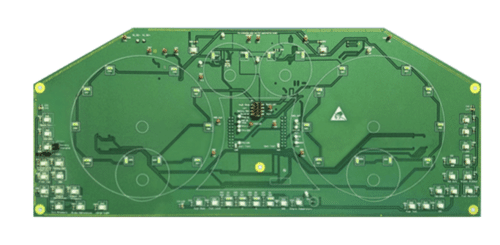
Texas Instruments’ automotive cluster driver notification reference design (TIDA-01628) provides design engineers with a development platform for building instrument cluster and driver notification systems. The reference design integrates automotive functions, including tell-tale indicators, ambient light sensing, backlight control, warning notifications, and embedded power management into a single architecture. By using this reference design, engineers can reduce development time, minimize hardware design risks, and accelerate system validation for automotive HMI applications.
One advantage of this reference design is the ability to reuse hardware building blocks in custom cluster designs. Engineers can leverage the power architecture, which includes automotive-grade boost and buck converter stages for generating system rails under varying vehicle operating conditions. The design demonstrates implementation methods for power sequencing, voltage regulation, transient protection, and noise management, allowing engineers to avoid redesigning these functions from scratch. This is valuable in automotive environments where electrical reliability and EMI performance are design considerations.
The reference design also provides a framework for implementing driver notification systems. Engineers can study and reuse the LED driver architecture, tell-tale control methods, and ambient-light-based brightness adjustment techniques demonstrated in the design. These features help developers create instrument clusters capable of maintaining visibility and readability across different driving and lighting conditions. The integrated ambient light sensing implementation further enables automatic backlight optimization, improving driver comfort and system efficiency.
Another benefit for design engineers is access to production-oriented design documentation. The reference package includes tested schematics, PCB layouts, BOMs, thermal considerations, and layout guidelines that can be referenced during product development. Engineers can use these materials to accelerate PCB design, optimize grounding and routing strategies, and validate thermal and electrical performance before prototyping their own systems. This reduces the number of design iterations required during development and helps shorten product development cycles.

On the software side, the reference design demonstrates an embedded control framework for managing cluster notifications and system states. Engineers can study how the embedded controller coordinates warning indicators, beam notifications, reverse indicators, and other vehicle status functions through a centralized state-machine architecture. This provides insight into designing automotive firmware capable of handling multiple real-time events while maintaining deterministic system behavior. The modular software structure can also be adapted and expanded for additional cluster features in future vehicle platforms.
The design is useful for engineers developing automotive HMI systems that require integration of sensing, lighting, and notification functions within embedded architectures. It serves as both a development platform and a learning platform for understanding automotive-grade implementation practices. By reusing the hardware concepts, firmware structures, and system-level design methodologies provided in this reference design, engineering teams can prototype and customize cluster notification solutions while improving reliability and reducing time-to-market.
TI has tested this reference design. It comes with a bill of materials (BOM), schematics, assembly drawing, printed circuit board (PCB) layout, and more. The company’s website has additional data about the reference design. To read more about this reference design, click here.