A humidifier reference design helps control mist, adjust output, detect low water, and track frequency for ultrasonic humidifiers.
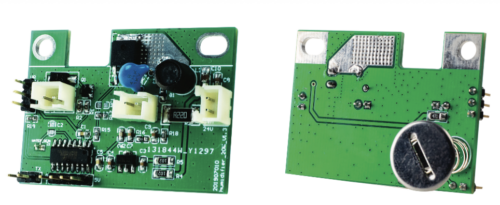
Holtek’s 1.7MHz/24V/20W humidifier reference design shows how an MCU can be used to control an ultrasonic atomizer while handling frequency tracking, water detection, mist adjustment, touch-key input, and fan control. The design can be used by engineers as a starting point for developing humidifiers, aroma diffusers, and other products that generate mist from liquid.
The design uses a PWM signal from the MCU to directly drive an external MOS transistor. The transistor drives an inductor-boost circuit connected to the atomization film. The film oscillates at high frequency, breaking water into fine mist. Unlike a self-driving oscillation circuit, this approach allows the MCU to control the atomizer frequency. It can also reduce heat dissipation requirements for the external transistor.
The hardware is divided into four main sections: power supply, atomizer driving and frequency tracking, fan driving, and mist-output control with capacitance-based water detection. Engineers can use these sections as a starting point and adapt the circuit according to the requirements of their products.
During frequency tracking, the MCU changes the PWM frequency from a higher value toward a lower value while monitoring the current through a current-sampling circuit. When the measured current reaches the target value, the corresponding frequency is selected as the atomizer’s operating frequency. This allows engineers to use frequency tracking instead of relying on a fixed operating frequency.
The MCU output can provide up to 150mA, allowing direct drive of the external MOS transistor without a separate driver. Four slew-rate levels are also available, allowing engineers to select the required output drive characteristic.
The design also provides capacitance-based water detection. A software library and detection algorithm are provided for this function, with designers required to configure the relevant parameters. When the system detects that the water has run out, the atomizer is switched off to prevent operation without water.
Mist output can be adjusted using a potentiometer connected to the MCU’s ADC. The software reads the potentiometer value and changes the mist output accordingly. A touch key can be used to start or stop atomization.
Before using the capacitance-based water detection, the system needs to be calibrated with an empty tank. During initial power-up, the tank is kept empty so that the system can establish the empty-tank condition for detection.
Testing of the reference design recorded 17W for the atomizer, 1W for the fan, and 21W total input power at the adapter. The external MOS transistor reached 63°C, while average mist output was 250mL/h. The design also passed conducted-disturbance testing from 150kHz to 30MHz, disturbance-power testing from 30MHz to 300MHz, and radiated-emissions testing from 30MHz to 1GHz.
Holtek has tested this reference design. It comes with a bill of materials (BOM), schematics, assembly drawing, printed circuit board (PCB) layout, and more. The company’s website has additional data about the reference design. To read more about this reference design, click here.