





Reference design provides a high-efficiency two-stage DC-DC converter that delivers 1.2 V at 100 A from a 48 V server power bus.
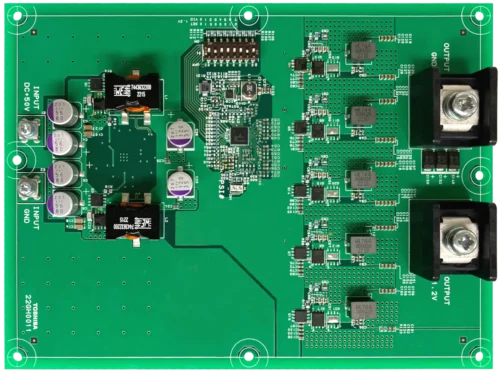
Toshiba Electronic Devices & Storage Corporation has developed a reference design for a 48 V bus-compatible DC-DC converter that supplies 1.2 V at 100 A to devices used in server systems. Designed to address increasing power consumption in data centres, the two-stage converter provides an efficient method of reducing the bus voltage for processors and other board-level devices. The design also provides circuit information and design resources to help engineers develop server power systems.
The converter accepts a DC input voltage ranging from 40 V to 59.5 V and provides a 1.2 V output with a maximum current of 100 A. The converter uses a two-stage, non-isolated synchronous buck configuration. The first stage steps down the input voltage to approximately 12 V, while the second stage further reduces it to 1.2 V. The first stage steps down the input voltage to approximately 12 V, while the second stage further reduces it to 1.2 V.
The first stage uses a two-phase configuration, while the second stage uses a five-phase configuration to support the high output current. Both stages use power MOSFETs as switching devices and synchronous rectifiers. The selected power MOSFETs provide a balance between on-resistance and charge characteristics. The design achieves a total efficiency of 83% at a 50 V input and full-load condition.
The reference design uses a printed circuit board measuring 198 mm × 151 mm for server power applications requiring high current and efficient voltage conversions.It provides a low-voltage, high-current output for devices used in server systems. Toshiba also provides information on circuit operation and design considerations, enabling engineers to evaluate the design and adapt it for their applications.
The design package includes a reference guide, design guide, circuit diagram, bill of materials and PCB layout information. Editable circuit and PCB design data are also available in formats compatible with various electronic design automation (EDA) tools, along with PCB fabrication data.
For more information, click here.
