

Design enables wireless monitoring and control of brushed DC motors using Bluetooth LE for consumer, industrial and medical applications.
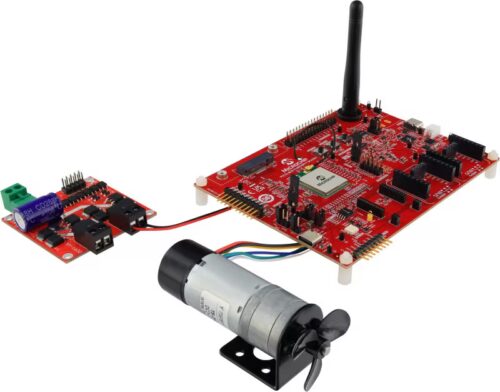
Microchip has introduced a reference design for Bluetooth Low Energy (LE) based brushed DC motor control. As a proof of concept, intended for consumer, industrial and medical applications, the system uses hardware, firmware and an application that enables engineers to develop Bluetooth LE-based motor control solutions. Motor startup/stopping, speed control and velocity monitoring capabilities are offered by the mobile application.
The system creates a Bluetooth LE link between the wireless controller on board and a mobile application. After connecting to the system, users are able to remotely control the operation of a motor including its starting, stopping and changing the speed. The wireless controller provides pulse width modulation (PWM) signals to control the speed and direction of motor rotation, while the velocity values are sent back to the application.
The demo application includes example firmware, hardware integration guidance, a mobile application interface and sample source code. This set of materials aims at helping the user to evaluate and prototype Bluetooth LE motor-control applications by demonstrating their real implementation for speed and direction control based on PWM.
The hardware setup consists of the following components: a brushed DC gearmotor with an integrated quadrature encoder, which can be used as velocity feedback for the closed-loop motor-control application; and the dual-channel motor driver, which drives and controls the brushed DC motor.
The development platform features a 128 MHz Arm Cortex-M4F core with 2 MB Flash memory and 512 KB RAM. This hardware offers features such as wireless connectivity through Bluetooth LE, Thread and Matter connectivity, and also features Dual CAN FD ports, 10/100 Mbps Ethernet, Full-Speed USB, Quadrature Encoder Interface (QEI), touch-sensing and graphics capability. The security aspects offered by the hardware are Secure Boot ROM and On-Chip Security Engine offering features like AES, SHA, ECC and TRNG. The platform is qualified to AEC-Q100 Grade 1.
Other board features include accessible I/O pins, mikroBUS and Xplained Pro connectors, a graphics connector, USB Type-C for power and programming, RMII Ethernet, CAN FD and an On-Chip temperature sensor. The development ecosystem supported by this development platform includes MPLAB IDE, Zephyr RTOS, and reference designs and code examples.
Hardware resources as well as supporting documents have been included in the reference design to support evaluation and development of isolated power-supply designs. They include schematics, PCB files and connection diagrams.
For more information, click here.