




A Bengaluru startup is turning factories into intelligent spaces with tiny UWB tags, AI-powered visibility, and real-time tracking that can automate workflows, improve safety, and prepare industries for Physical AI.
Factories and warehouses have become smarter with automation, connected machines, and AI systems. Yet a major gap remains: industries still lack complete visibility into physical environments. Workers spend valuable time searching for trolleys, scanners, tools, and materials, while many workflows still rely on repetitive barcode or RFID scanning. Safety also remains a challenge because worker locations are not always known during emergencies. While AI has transformed digital operations, physical environments remain largely disconnected and invisible.
This challenge inspired AmiMotion. Founders Kaushal Kukkar, CTO Vivek Dham, and Chief Business Officer Sumeer Bhatara observed that AI has become powerful because companies like Google have organised internet information into structured data. However, no similar intelligence layer existed for the physical world. This led to the establishment of AmiMotion, a Private Limited company headquartered in Bengaluru in 2024.
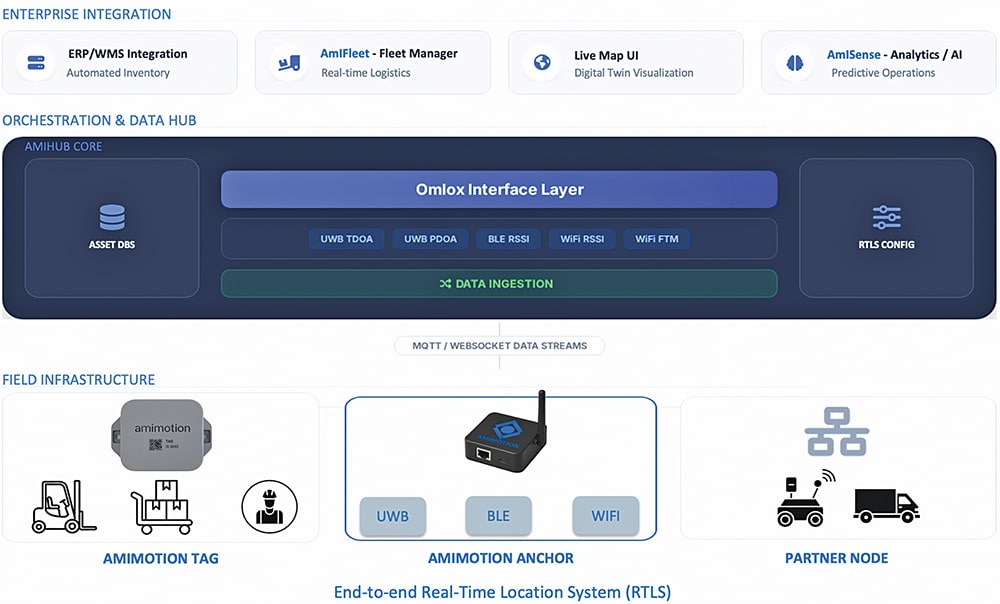
The name AmiMotion stands for ‘Ambient Intelligence for Motion.’ Technologically, the company develops an end-to-end platform integrating hardware, embedded systems, wireless communication, AI models, and software infrastructure. On the business side, it follows a scalable product-plus-subscription model using strategic partnerships and channel-based deployment rather than relying on large direct sales teams.
Developing this involved significant engineering challenges. The first was miniaturisation. Devices had to be small enough to attach to workers, forklifts, trolleys, scanners, machines, and materials. The company solved this by developing what it calls the world’s smallest ultra-wideband (UWB) tag, measuring only 3cm×3cm.

The second challenge was ecosystem compatibility and scalability. Existing solutions often operate within proprietary ecosystems. AmiMotion instead created an open, vendor-agnostic architecture capable of integrating with third-party systems. The solution was built entirely in-house without external IDHs or design houses. Founder Kaushal brings over 20 years of embedded systems and software experience from Intel and Texas Instruments, while Vivek contributes over 25 years of experience in RF and wireless hardware.
The technology combines embedded systems, RF design, UWB, Bluetooth Low Energy (BLE), Wi-Fi, sensors, AI algorithms, and edge computing. Compact tags attached to moving assets collect location data, while ceiling-mounted anchors receive signals and feed them into the company’s platform. The software converts this into a live digital representation of physical environments. Applications such as AmIFleet and AmISense provide analytics, fleet management, process optimisation, and operational insights. The system also integrates with GPS, robots, RFID systems, smartphones, and third-party platforms.
Instead of becoming a services-led company, the company uses a channel-driven approach: products and software are developed internally, while system integrators and partners handle deployments. Software follows a subscription model, enabling global scalability without building large operational teams.
For manufacturing, it follows an asset-light model. It owns product architecture, PCB design, module design, hardware ecosystem development, and enclosure design, while production is outsourced to Indian electronics manufacturing partners. Components come from companies such as NXP, Infineon, and Texas Instruments. This outsourcing allows the company to focus on innovation rather than manufacturing infrastructure, while production remains partner-driven.
Commercial deployment has started with around 50 to 100 tags across four customers, including Maruti, Volvo, Marmon, and Nati Motors. Revenue generated so far is ₹4-5 million, with the current financial year (FY) turnover expected to be around ₹3 million. The company projects revenue of nearly $1 million by 2027 and $4-5 million by 2028.
AmiMotion has already expanded from one manufacturing vendor to three. It currently works with six channel partners across Asia-Pacific and two in Europe and North America, targeting around twenty partnerships.
