




An Indian startup is building humanoid robots in-house. The robots are trained like workers, tested in controlled spaces, corrected using feedback, and improved through repeated practice.
Three friends from Kerala—Athil Krishna, Akhil K. Haridasan, and Sarath S.—began working on humanoid robots for defence and real-world applications. After months of developing proposals, they submitted multiple ideas to the government in 2019, highlighting the importance of humanoid robots for the army. In 2020, the BSF and PMO responded, with the BSF expressing interest in a demo. However, the Covid pandemic disrupted progress. Without a working prototype and having already returned to Kerala, the team could not present the demonstration.
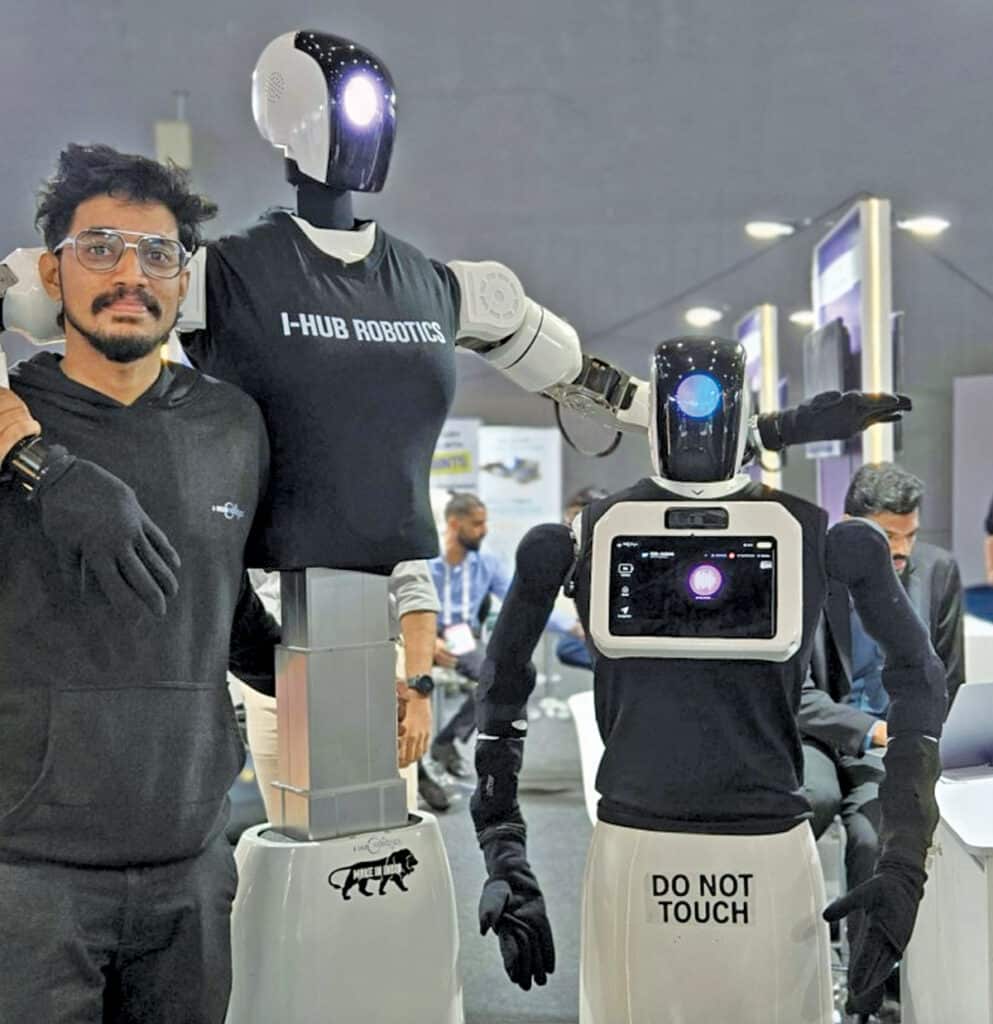
They resumed work in 2022 and founded iHub Robotics (Innovation Hub for Robotics) to develop robotics solutions.
The company builds humanoid robots in India. Its first product, Tara Generation 1, launched in 2024 as a service humanoid robot capable of speaking more than 100 languages, displaying human-like behaviour, and autonomously navigating spaces up to 400,000 square feet (approx. 37,160 square metres). Tara is available in variants such as Tara Greet, Tara Lean, and Tara Care for applications across healthcare, education, offices, and general services.
After Tara, the company built its second major system, Daksha, a general-purpose industrial humanoid robot. Daksha is designed for heavy industrial environments and can lift payloads of up to 25kg, making it one of the strongest humanoid systems in its category. It can also move vertically, operating at heights of up to 8-10 feet (2.4-3 metres) for industrial tasks.
The company is also developing India’s first indigenous ‘Viveka Decision Core,’ an advanced brain-like orchestration system that powers these robots and controls decision-making and movement.
“We are working on an advanced AI called VLA (Vision Language Action). Unlike LLMs (Large Language Models), which mainly handle text and content generation, VLA goes one step further into ‘prompt to action.’ It connects vision (eyes), language (understanding), and action (movement). In simple terms, it helps robots see, understand, and physically act in the real world. A related concept is VLN (Vision Language Navigation), where robots can understand environments and choose paths on their own, like navigating multiple routes in an unknown space,” says Athil.
Speaking about the design challenges, Athil adds, “Designing a humanoid robot is complex because it functions like a human body with multiple mechanical and kinematic systems that require deep research and repeated prototyping before finalisation. The hardware is also challenging, with many joints and motors, each needing precise control, feedback, and voltage management. Integration with high-end computing boards adds another layer of difficulty. Over the last three years, we have developed our own hardware circuits and control boards, enabling faster development and greater independence. Most components today, including body systems, battery management, and main control boards, are built in-house.”
The company is headquartered in Kochi, Kerala, with manufacturing fully based in India at its Kalamassery factory.
“Currently, our setup is still in an early stage of scaling, using only around 3 to 4 GPUs for development work. Our near-term plan is to expand significantly, targeting the deployment of around 100 Nvidia Blackwell GPUs within our factory to support large-scale training and AI workloads. In parallel, we are also focusing on adding more advanced machining infrastructure, especially high-end CNC and cutting systems, to improve our in-house actuator manufacturing and overall production capability,” says Athil.
Testing and verification are central to the company’s workflow, with every stage evaluated through both simulation and real-world execution. The company uses software-based virtual training and simulation systems to train and test robots with large amounts of data. At the same time, testing also takes place in its factory environment. The company has built an industrial training corridor, now expanded to around 24,000 square feet (approx. 2230 square metres), used for real-world robotic testing and development. In this setup, robots repeatedly learn tasks like picking and placing objects, correcting errors, and improving performance through repetition.
“In 2024, we raised around ₹45 million from US angel investors while continuing to operate on internally generated revenue from early projects and prototypes. Government funding has not come yet, but we are applying for research grants and collaborating with agencies like IDX,” explains Athil.
The company has signed multiple MoUs with major firms, including EY Global and SAP Germany, as well as several leading Indian IT and industrial companies. It is also building academic partnerships, with an industrial humanoid R&D centre being set up in Bengaluru and joint development work starting next month. At the same time, the company is actively seeking channel partners across India to grow its presence in both industry and education.
Looking ahead, the company plans to build structured sales channels in the US and European markets as it expands operations. A US office is also planned before the end of 2026. Its long-term vision includes global expansion across North America, South America, and Europe, along with scaling production capacity. The company currently produces around 300 humanoid robots per month and aims to fully utilise this capacity within the next two years. Its vision is to scale indigenous humanoid robotics from India and supply advanced systems to global markets.


