




A new technique of training artificial intelligence has been devised by scientists from MIT, which could speed up climate modeling and allow making predictions about unknown emissions scenarios.
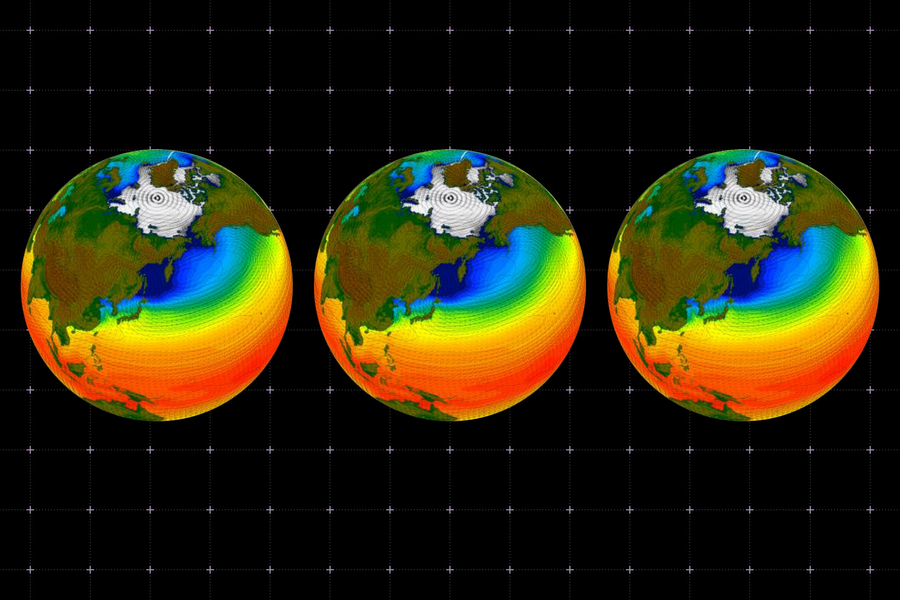
Researchers from the Massachusetts Institute of Technology (MIT) created a technique of training artificial intelligence (AI) which could speed up the process and make climate prediction models more flexible and accurate. This technique involves generation of optimized synthetic training data and allows using climate emulators based on AI to predict unknown climate scenarios with much less computationally expensive simulations needed.

Climate emulators are artificial intelligence systems created to mimic large scale Earth System Models (ESM). Such models describe physical processes within the climate system of the Earth and predict changes in temperatures, precipitation, and sea level changes depending on greenhouse gas emissions. Nevertheless, running an ESM simulation on a supercomputer takes several months to run just one possible climate scenario.
However, they rely on a large amount of quality training data and therefore cannot predict climate under conditions substantially different from the training set. In the conventional approach, the training dataset includes six to eight plausible emissions scenarios. Thus, the performance of climate emulators is highly dependent on the type of data and cannot be generalised.
In their study, scientists from the Massachusetts Institute of Technology have managed to overcome this disadvantage. Their method involves using a special algorithm that creates artificial climate scenarios to increase the predictive power of a particular climate emulator. The conventional approach requires running several costly ESM simulations; however, in the new algorithm, one simulation will suffice for obtaining training data.

The algorithm starts with selecting a random climate scenario created by a climate model of a lower order. Then the error of the emulator’s predictions is estimated by comparing the results of both models. Finally, the optimisation process fine-tunes the artificial training scenarios to decrease this error.
Unlike the typical datasets, whose trends tend to be smooth and realistic with respect to emission trends, the created datasets incorporate fast fluctuations in emissions of carbon dioxide and methane. Fast fluctuations assist the AI model in learning the climate system better, hence enabling it to handle situations outside the training dataset.
The researchers found out that the trained emulator was able to predict situations not in the training dataset, such as a policy of controlling pollution within a region where one pollutant is decreased and the other emissions increased.


