One setup brings data, AI training, and testing together, helping teams check AI-based network functions before real-world use.
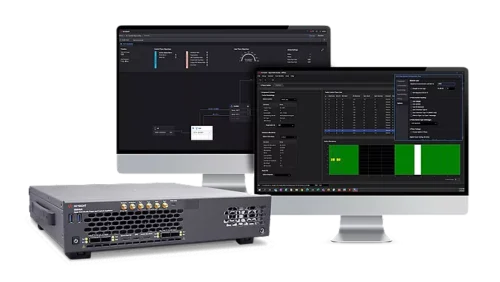
Keysight Technologies, Samsung Electronics, and NVIDIA have put together a working AI-RAN validation flow that brings data generation, AI/ML training, and benchmarking into one setup. The focus is on testing AI-driven RAN modules using the Physical Uplink Shared Channel (PUSCH) channel estimation use case. The goal is to make validation faster and reduce deployment risk for operators and vendors.
The setup runs on an integrated platform that connects Keysight’s AI-RAN Simulation Toolset with the NVIDIA Aerial Testbed. It uses systems such as NVIDIA GH200 and NVIDIA DGX Spark, along with the NVIDIA Aerial Omniverse Digital Twin. Commercial radio hardware, including Analog Devices’ Titan O-RU platform, is also part of the test environment. AI/ML models developed by the three companies are trained and benchmarked within the same workflow so results can be measured in a consistent way.
The need for this kind of workflow comes from the way AI is entering the RAN. Engineers must validate algorithms across many real-world network conditions. In most cases, data collection, model training, and performance testing are done in separate environments. That separation makes it difficult to compare results, repeat experiments, and confirm reliability before deployment—especially for physical-layer tasks like channel estimation that directly affect throughput and network stability.
Keysight’s AI-RAN Simulation Toolset addresses this by orchestrating the entire process end to end. It automates scenario creation, dataset generation, model training, and repeatable benchmarking in one controlled environment. The companies are showcasing this workflow at Mobile World Congress 2026 in Barcelona, where the full chain runs on partner compute and radio platforms to demonstrate how AI-driven RAN behavior can be validated before field trials.

Soma Velayutham, Vice President, AI & Telecoms, NVIDIA, said: “By leveraging NVIDIA AI Aerial platforms into a unified workflow, Keysight is simplifying the end-to-end data pipeline, essential for training, validating, and deploying AI-native 5G and 6G networks.”
Charlie Zhang, Executive Vice President, Samsung Research America, said: “This collaboration empowers the industry to confidently adopt AI-driven RAN solutions, ensuring robust and commercially viable foundations for the future of 6G networks.” Balaji Raghothaman, Chief Technologist-6G, Keysight, said: “AI in the RAN only delivers value when it can be validated with confidence.”