




Researchers have developed a new lithium battery that reaches 467Wh/kg without a conventional graphite anode.
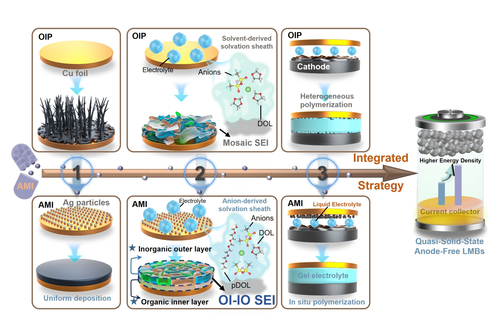
Researchers at the Hong Kong University of Science and Technology (HKUST) have developed a lithium battery that does away with the anode, one of the two main electrodes in a conventional cell. The prototype achieved a specific energy of 467 watt-hours per kilogram (Wh/kg). The new approach could help batteries store more energy per kilogram, which lets a phone last longer or an electric car drive further on the same weight of battery.
In conventional lithium-ion batteries, the anode is usually made of graphite, which stores the lithium during charging. An anode-free cell skips that layer and uses bare copper foil, and lithium from the cathode plates directly onto the copper during charging. Removing the graphite saves weight and space, and it simplifies manufacturing.
Lithium tends to deposit unevenly on bare copper, forming needle-like spikes called dendrites. These can damage the battery over repeated charging cycles and can cause internal short circuits. The protective film that forms on the metal, the solid electrolyte interphase (SEI), is also unstable.
The HKUST team, led by Professor Shao Minhua from the Department of Chemical and Biological Engineering, addressed these problems using a compound called AMI. The additive combines silver ions with anions and helps regulate lithium deposition on the copper surface. The silver encourages lithium to spread more evenly, while the anions trigger a reaction that forms a gel within a protective, two-layer film.
“The key is not simply adding a silver salt or a polymerisation initiator,” Shao said in the university’s release.
This structure creates a quasi-solid-state environment, combining features of liquid and solid-state battery systems. By improving lithium deposition and stabilising the protective layer, the approach aims to reduce the degradation that has limited anode-free batteries.
According to the team, a pouch cell achieved a specific energy of 467Wh/kg. A separate coin cell retained 90 per cent of its capacity after 200 charge-discharge cycles. These results demonstrate the potential of the chemistry, although the energy-density and cycle-life figures come from different cell formats.
For comparison, conventional lithium-ion cells generally have lower specific energy, with the exact figure depending on their chemistry and design. The higher value reported by the HKUST team could allow a battery to store more energy at the same weight. In principle, this could benefit electric vehicles, drones and other applications where battery weight is a concern.
However, the results are still at the laboratory stage. The reported cycle-life performance does not establish how a high-energy pouch cell would perform over hundreds of cycles under practical operating conditions. The cost of the silver-based additive, its availability at large production volumes and the challenges of scaling up the manufacturing process also remain important questions.
The development could be relevant to India’s growing battery manufacturing industry, supported by the Production Linked Incentive scheme for Advanced Chemistry Cell batteries. An anode-free design could reduce the need for graphite in the cell, but manufacturers would need to assess the economics of the silver additive and the reliability of the chemistry before considering commercial production.
For Indian battery makers, the next step will be to establish whether the technology can maintain its energy density over repeated charging cycles while remaining affordable to manufacture. Until then, the reported 467Wh/kg figure is a promising laboratory result rather than a performance level that consumers can expect from commercially available batteries.
For more information, click here.


