




Need EMI suppression in high-voltage systems? These X1 capacitors withstand harsh conditions and humidity. Find out how they can improve your design.
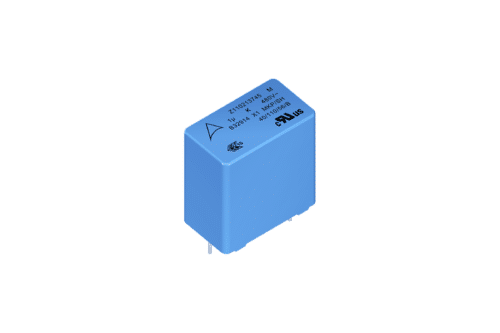
TDK Corporation has launched the EPCOS B3291xH/J4 series of X1 capacitors for power line filtering in automotive and industrial applications. Designed for demanding environments, these capacitors support AC voltages up to 480 V and are well-suited for applications like PV inverters and EV onboard chargers (OBCs) that face high humidity conditions. With a continuous DC voltage handling capacity of 1000 V, they provide a solution for DC EMC in high-voltage EV platforms.
The X1 capacitors undergo THB testing at +85 °C, 85% relative humidity for 1000 hours at 380 V (AC) and 1000 V (DC) and can operate at temperatures up to +110 °C.
They feature self-healing properties and offer capacitance values from 15 nF to 10.0 µF in a compact form factor. Sizes range from 18.0 x 10.5 x 5.0 mm to 57.5 x 57 x 45 mm, with lead spacings between 15 mm and 52.5 mm. The largest models include 4 pins for better PCB stability. The series is certified by ENEC, UL, and CSA.
The X1 capacitors are designed for EMI suppression in automotive and industrial applications, meeting the X1 subclass of IEC 60384-14 for “across the line” (L to N) filtering. They are suitable for harsh ambient conditions and provide high-voltage DC EMC performance.
Some of the key features of the X1 capacitor include:
- High rated voltages: 480 V (AC), 1000 V (DC)
- THB Grade IIB (refer to IEC 60384-14:2013 AMD:2016)
- Climatic category (IEC 60068-1): 40/110/56
- Max. operating temperature: +110 °C
- Small dimensions
- Compliant with AEC-Q200 rev. E
Prolonged exposure of a film capacitor to humidity can cause irreversible damage. Direct contact with liquid water or extended exposure to high humidity or dew can erode the film metallization, leading to capacitor failure. Plastic-boxed capacitors should be tested under the worst expected temperature and humidity conditions in the final application to ensure that parameter drift does not affect circuit performance.
For more information, click here.
