An automotive lighting chip combines LED control and power conversion in one package, reducing heat and components while supporting RGB lighting designs.
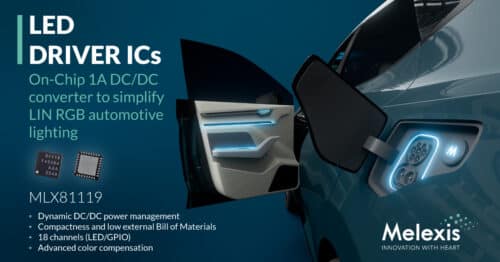
Melexis has introduced the MLX81119, an 18-channel LIN RGB LED controller with an integrated 1 A DC/DC converter for automotive lighting applications. The device is intended for installations such as dashboards, door panels, and EV charge-port lighting, where external power components and thermal management affect system design.
The MLX81119 integrates a programmable DC/DC converter that generates a local LED supply voltage between 2.5 V and 6 V. Instead of using a fixed external supply and dissipating unused voltage as heat, the controller adjusts the LED supply according to active color combinations and operating conditions. This reduces power loss, thermal load, and the number of external power components.
Automotive manufacturers are increasing the number of lighting functions across vehicle interiors and exteriors, adding pressure on PCB space and thermal budgets. Conventional RGB lighting systems often rely on external DC/DC converters, increasing component count and layout complexity. By integrating power management into the LED driver, the MLX81119 reduces the external power stage to two capacitors and one inductor.
The controller includes 18 low-side current sources configurable up to 60 mA with independent 16-bit PWM control, allowing one device to drive up to six RGB LEDs. The dimming system supports color transitions and lighting animations.
The device also includes direct and indirect temperature sensing with compensation across all channels to maintain color output across the automotive temperature range. The device can operate as a LIN-controlled power and I/O extension, allowing its 18 channels to support auxiliary loads and distributed functions within a module.
“With the MLX81119, we have created a solution that directly addresses the constraints facing modern automotive lighting designs,” said Michael Bender, Product Line Director at Melexis. “By integrating the DC/DC converter and dynamically adapting the LED supply voltage, engineers can simplify their designs, improve system efficiency, and scale lighting architectures without adding complexity.”
Click here for the original announcement.