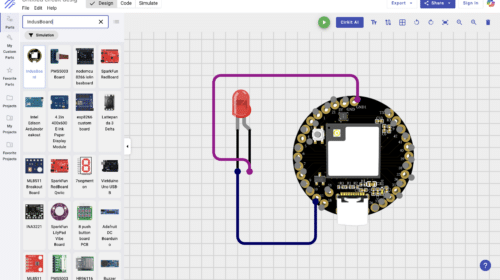
Explore a small board with sensors, versatile pins, and multiple connectivity options—designed for IoT projects. Read more!
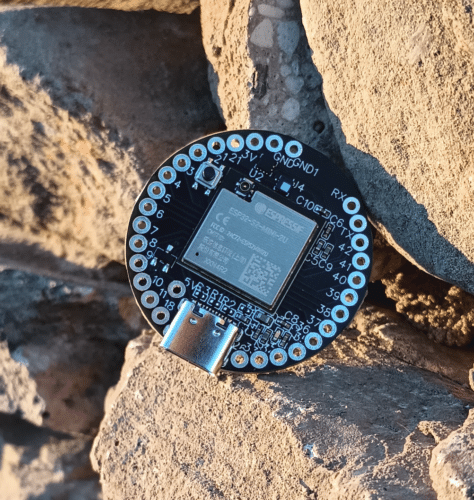
IndusBoard has introduced a new version of its board called Coin V2. It is coin-sized and has a redesigned layout that increases sensor density within its small form factor. Despite its size, Coin V2 has over 30 I/O pins and more than 5 sensors. These features make it suitable for IoT projects, offering many GPIO pins and integrated sensors in a compact design.
The Coin V2 board is helpful for many users, especially those working on IoT and small device projects. Its size, I/O pin count, and integrated sensors make it practical for IoT developers building smart homes, wearables, and connected devices. Electronics hobbyists and makers can also benefit from Coin V2. Its Arduino-compatible design, flexible circuit board, and JST battery connector simplify prototyping and customizing projects like monitoring systems or automation. Industrial designers and engineers may find the board helpful for sensor networks, monitoring systems, and embedded controls.
Educational institutions and students can use Coin V2 to learn about circuit design, programming, and IoT. Its compatibility with Circuit Designer software allows users to design circuits, simulate with AI tools, and program the board. Researchers and developers will find the board useful for experimental setups needing compact and sensor-dense solutions, such as proximity sensing, radon detection, or similar applications. Coin V2 supports a range of users, from beginners to experts, who need a small, functional board.
Smaller boards often have limitations like reduced processing power, fewer I/O options, or a lack of sensors. IoT projects needing compact boards are often limited to boards with 10–100 I/O pins, laser modules, or without sensors. Coin V2 addresses these challenges with features like an accelerometer, magnetometer, two temperature sensors (for chip and ambient measurements), a Lux sensor, a touch sensor, and over 10 capacitive proximity sensors. It also supports various physical layer interfaces, including I2C, SPI, USART, OTG, HID, I2S, TWAI (Can Bus), and Wi-Fi, making it adaptable for IoT use.
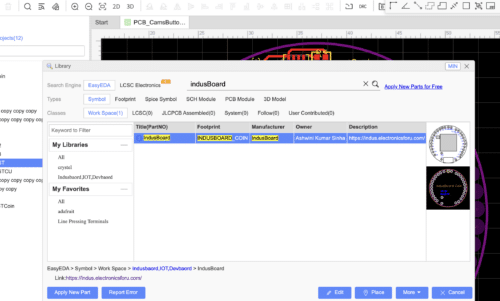
IndusBoard Now Supported in Circuit Designer
The Indus board is now supported in Circuit Designer, allowing users to design circuits graphically. With the AI feature in Circuit Designer, users can also generate code for their designs. Additionally, the Indus board is now present in EasyEDA, with its library and PCB footprint available. These can be further exported to other EDA software like Altium, Eagle, and more.