




A new high-energy CT system allows detailed inspection of large objects, enabling non-destructive testing of complex components while maintaining their original orientation and structure.
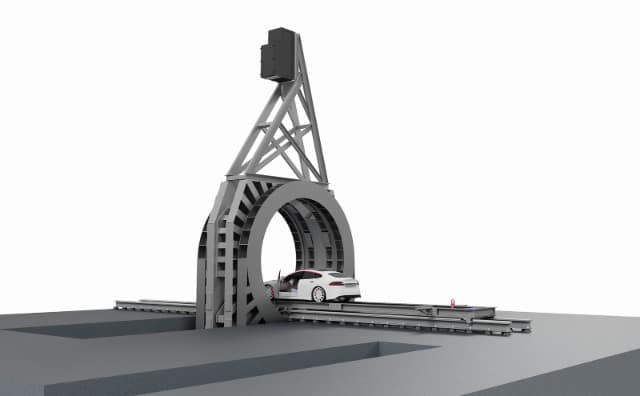
Non-destructive testing (NDT) allows engineers to inspect objects without opening or dismantling them. Traditionally, only items that fit inside conventional scanners could be analysed, limiting testing of large, complex components. The Fraunhofer Institute for Integrated Circuits IIS is addressing this challenge with its GiantEye project, developing a high-energy computed tomography (CT) system capable of scanning very large objects with unprecedented detail.
The institute’s previous XXL CT system, built in 2013, could scan entire vehicles and freight containers but required complicated handling and positioning of test objects. GiantEye’s design features a gantry similar to medical CT scanners, where the X-ray source and detector rotate vertically around the object. This allows large objects to remain in horizontal orientation, reducing mechanical stress and ensuring accurate measurement even in highly absorbent areas such as electric vehicle batteries. This method opens the door for routine industrial testing, including early production of complex high-voltage battery systems and is expected to be available to industrial partners by early 2027.
The project’s key features include a nine mega electronvolt linear accelerator, high-precision manipulation, and a detector system capable of 3D resolutions down to 100 micrometers. These features allow radiography of dense materials, including full vehicles, aircraft components, and large batteries, while minimizing imaging artifacts. Its horizontal gantry design reduces measurement time, improves image quality, and enhances safety for test objects.
The system’s industrial architecture also enables efficient, routine scanning without extensive preparation. Potential applications span automotive crash test analysis, final inspection of additively manufactured components, and diagnostics of large engine parts.


