




HomeElectronics NewsInjectable Antennas For Medical Implants

Injectable Antennas For Medical Implants

What if implants like pacemakers or glucose sensors didn’t need batteries or surgery? Tiny antennas you can inject could power them through the skin.
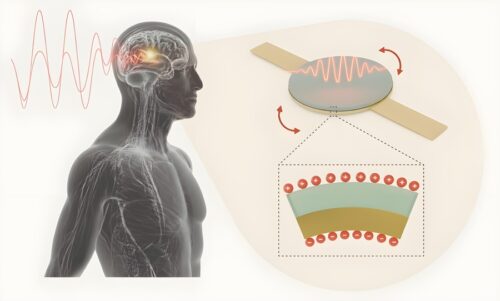
A tiny, injectable magnetoelectric antenna implanted deep in the brain can receive power from low-frequency external magnetic fields. “Our technology has the potential to introduce a new avenue for minimally invasive bioelectric devices that can operate wirelessly deep within the human body,” says MIT Associate Professor Deblina Sarkar.
Credits:Image: Baju Joy
A tiny, injectable magnetoelectric antenna implanted deep in the brain can receive power from low-frequency external magnetic fields. “Our technology has the potential to introduce a new avenue for minimally invasive bioelectric devices that can operate wirelessly deep within the human body,” says MIT Associate Professor Deblina Sarkar.
Credits:Image: Baju Joy

If you’ve ever thought about how pacemakers or implants for conditions like epilepsy and Parkinson’s get their power, it’s not as simple as plugging them in. Right now, most deep-tissue implants either use a battery that’s several centimeters long and needs surgery to replace, or a magnetic coil that works wirelessly but only at high frequencies. That can heat tissue and makes it hard to safely power tiny implants.

- Advertisement -

We’re seeing a new approach from MIT Media Lab. They’ve made an antenna about the size of a grain of sand that you could inject into the body. This tiny antenna can wirelessly power implants and generates 10,000 to 100,000 times more power than similar tiny metallic coils. The power comes from a magnetic field created by a device like a small wireless phone charger, which you could wear as a patch or keep near your skin.

“This is the next major step in miniaturizing deep-tissue implants,” says Baju Joy, a PhD student in the Media Lab’s Nano-Cybernetic Biotrek research group. “It enables battery-free implants that can be placed with a needle, instead of major surgery.”

Because the antenna uses standard microchip technology, we can integrate it with other electronics. The electrodes and circuits can be even smaller than the antenna and can all fit together during fabrication, letting the whole system be delivered through a needle. These antennas can be made at scale, and we could inject multiple ones if we need to cover a larger area.

- Advertisement -

It’s not just about pacemakers or neuromodulators. This could help with glucose monitoring too. There are already circuits with optical glucose sensors, but adding a tiny wireless power source could make them much easier to use inside the body. And because it’s built with familiar fabrication methods, we can combine it with other existing technologies without starting from scratch.


Nidhi Agarwal
Nidhi Agarwal
Nidhi Agarwal is a Senior Technology Journalist at Electronics For You, specialising in embedded systems, development boards, and IoT cloud solutions. With a Master’s degree in Signal Processing, she combines strong technical knowledge with hands-on industry experience to deliver clear, insightful, and application-focused content. Nidhi began her career in engineering roles, working as a Product Engineer at Makerdemy, where she gained practical exposure to IoT systems, development platforms, and real-world implementation challenges. She has also worked as an IoT intern and robotics developer, building a solid foundation in hardware-software integration and emerging technologies. Before transitioning fully into technology journalism, she spent several years in academia as an Assistant Professor and Lecturer, teaching electronics and related subjects. This background reflects in her writing, which is structured, easy to understand, and highly educational for both students and professionals. At Electronics For You, Nidhi covers a wide range of topics including embedded development, cloud-connected devices, and next-generation electronics platforms. Her work focuses on simplifying complex technologies while maintaining technical accuracy, helping engineers, developers, and learners stay updated in a rapidly evolving ecosystem.

SHARE YOUR THOUGHTS & COMMENTS

EFY Prime

Unique DIY Projects

Electronics News

Truly Innovative Electronics

Latest DIY Videos

Electronics Components

Electronics Jobs

Calculators For Electronics
