What if a chip never needed charging? It runs on ambient light while sensing and processing data, bringing battery-free electronics closer to everyday use.
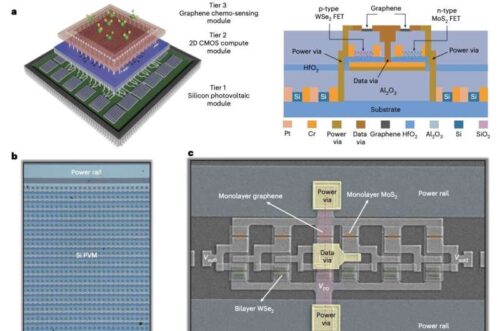
Researchers at Penn State University have developed a compact integrated circuit (IC) that runs entirely on ambient light while sensing chemicals and processing data without an external power source. The chip combines energy harvesting, sensing and computing into a single three-layer design, bringing battery-free electronics closer to practical use.
The work, published in Nature Electronics, is aimed at future Internet of Things (IoT) and edge computing devices that need to operate for long periods in remote or hard-to-reach locations where replacing batteries or connecting to a power source is difficult.
The chip consists of three vertically stacked layers. The bottom layer is a silicon photovoltaic module that captures energy from ambient light. The middle layer contains low-power logic circuits built using two-dimensional semiconductor materials—n-type molybdenum disulfide (MoS₂) and p-type tungsten diselenide (WSe₂) transistors. The top layer uses graphene-based chemical sensors to detect liquids and other substances.
When a liquid comes into contact with the graphene sensors, their electrical properties change. These signals travel through vertical interconnects to the logic layer, where they are converted into digital data. The entire sensing and computing process is powered by the light-harvesting layer integrated into the same chip, eliminating the need for an external power supply.
According to the researchers, the three layers are separated by only about 50 nanometres, making it one of the most compact light-powered chips demonstrated so far. The close integration reduces interconnect length, lowers energy loss and allows sensing, computation and power generation to take place within a very small footprint.
The team combined silicon, graphene, MoS₂ and WSe₂ in a single monolithic three-dimensional structure instead of placing separate chips side by side. This approach simplifies the system while improving efficiency.
The researchers believe the technology could be used in battery-free environmental monitoring systems, smart infrastructure, healthcare devices and other edge computing applications that require long-term operation without maintenance.
The next phase of the project will focus on building larger two-dimensional CMOS circuits, adding more types of sensors, improving photovoltaic and energy-storage performance, integrating low-power wireless communication and making the manufacturing process suitable for large-scale production.