As AI pushes memory interfaces to higher speeds, can testing keep pace without sacrificing signal integrity or production throughput? A test platform can target both.
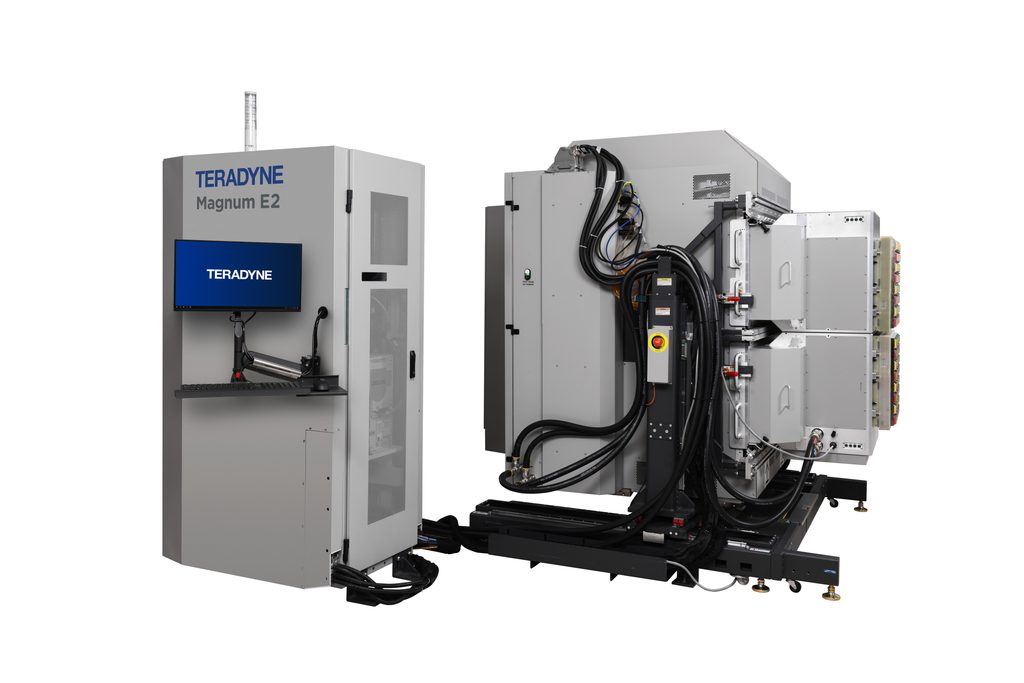
Teradyne has introduced Magnum E2, a high-speed memory test system for advanced DRAM and NAND interfaces as AI and high-performance computing drive faster memory technologies. The platform supports qualification through high-volume manufacturing on a common hardware and software foundation.
AI systems increasingly rely on faster memory to support intensive training and lower-latency inference. DRAM and flash devices are moving towards higher speeds, wider I/O and PAM3 signalling, making it harder to maintain signal integrity while testing more devices in parallel. Manufacturers therefore need test systems that can combine electrical accuracy with production throughput.
Magnum E2 addresses this through a Near-DUT Test architecture that places digital instruments close to the device under test. The shorter signal path is designed to preserve signal integrity and AC margin at higher operating speeds, helping manufacturers maintain test performance without sacrificing parallelism.
The system supports high-speed NRZ, PAM3 and PAM4 signalling through a flexible, programmable automatic pattern generation architecture. Its common hardware can accommodate current and emerging DRAM and NAND standards, allowing manufacturers to extend test capabilities as memory interfaces evolve.
Higher pin counts and parallel test capability support production throughput, while integrated logic-test functionality allows memory and logic testing on a single platform. This can help reduce separate test insertions and simplify test programmes as memory and logic functions increasingly converge.
The platform targets LPDDR6, DDR6, GDDR7 and NAND flash, including memory used in enterprise solid-state drives. It supports both engineering and production configurations, allowing manufacturers to use the same foundation from device qualification through volume manufacturing.
“The memory inside an AI accelerator is as critical to system performance as the compute die itself, and the test requirements have never been more demanding,” says Ben Han, president of the Memory Test division at Teradyne.
Click here for the official announcement.