




Can microscopic water channels inside chips dramatically cut cooling energy while helping AI processors handle rising computational demands?
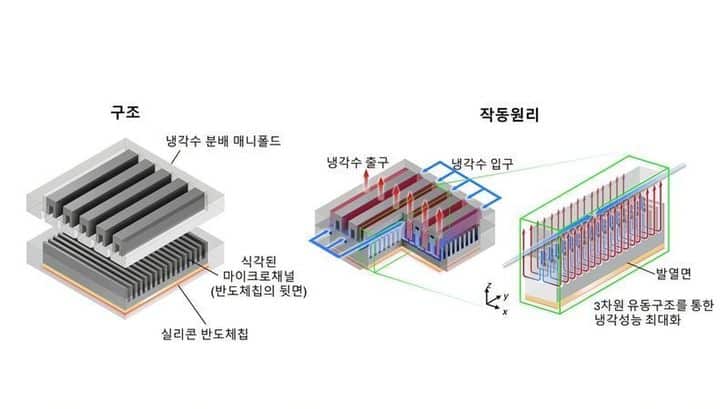
Researchers at the Korea Advanced Institute of Science and Technology (KAIST) have developed a liquid cooling technology designed to improve heat management in high performance semiconductors while significantly reducing the energy required for cooling.
As AI workloads continue to push processors to higher power densities, cooling has become one of the biggest challenges for data centers and advanced computing systems. Conventional cooling methods often consume substantial energy while struggling to keep pace with rising heat generation. The newly developed approach aims to address both issues by improving heat removal efficiency and reducing cooling power requirements.
The technology integrates microscopic cooling channels, thinner than a human hair, directly into semiconductor chips. These channels are combined with a manifold structure that distributes coolant through multiple pathways, reducing the distance water must travel and minimizing energy losses during circulation.
A key advantage of the design is its ability to deliver coolant more uniformly across the chip. Earlier manifold microchannel cooling systems often suffered from uneven flow distribution, causing some regions to receive less cooling than others. The researchers optimized the channel architecture to ensure more balanced coolant delivery, improving overall thermal performance.
Tests conducted on silicon wafer prototypes demonstrated a coefficient of performance of 106,000, meaning a single unit of cooling energy can remove 106,000 units of heat. According to the research team, this exceeds a previously reported benchmark by more than ten times. The system operates using room temperature water and avoids the need for boiling based cooling, nanostructured surfaces, or costly materials such as diamond.
The cooling principle was also applied to data center cold plates, where it delivered more than 30 percent higher cooling performance compared to conventional designs. Because the technology can be integrated into existing semiconductor manufacturing processes, it could offer a practical path toward more energy efficient AI infrastructure and high performance computing systems.

