




Traditional plasmonic biosensors rely on bulky optical setups. A semiconductor chip packed with tiny lasers hints at a far more compact sensing architecture for portable electronics.
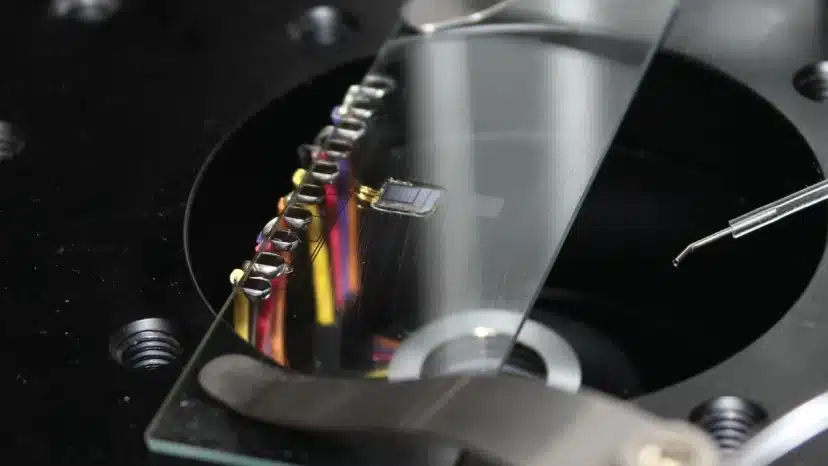
Researchers at Chalmers University of Technology have developed a miniature laser technology that could support the development of compact biosensors capable of performing certain laboratory tests outside traditional clinical environments. The approach integrates both the laser source and optical components on a semiconductor chip about one centimetre in size, enabling significantly smaller sensing systems. Such devices could allow some medical sampling to be carried out in patients’ homes rather than hospitals, potentially reducing the need for frequent clinic visits.
The technology is designed for optical biosensors based on Surface Plasmon Resonance, which is commonly used to study interactions between biomolecules. In these sensors, light is directed onto a gold surface, and small changes in reflected light are measured when biomolecules bind or interact on that surface. Conventional systems typically require bulky optical components such as prisms to direct the laser beam at precise angles, making them relatively large and complex to align and install.
To address this limitation, the research team developed a chip that integrates both the light source and the beam shaping optics. The device contains hundreds of microscopic lasers, each measuring approximately 200 by 250 micrometres. Integrating these elements directly onto a semiconductor chip enables a compact and lightweight optical system that could form the basis of portable sensing instruments.
According to the researchers, the integrated design may also support large scale manufacturing of the laser sources, which could help reduce costs for biosensor platforms that rely on this type of optical detection. The team is currently evaluating the sensor’s ability to perform tests such as measuring C reactive protein levels, a commonly used biomarker for inflammation and infection.
The researchers plan to further improve the sensitivity of the sensor and increase the number of samples that can be analysed simultaneously. The study describing the technology was published in ACS Sensors.
Erik Strandberg, doctoral candidate in photonics at Chalmers and lead author of the study says, “With this technology, we want to create an instrument that allows healthcare professionals to take certain samples in the patient’s home.”

