

The ultra-low-power GNSS platform combines dual-band positioning, Selective L5 technology and advanced firmware features for battery-powered applications.
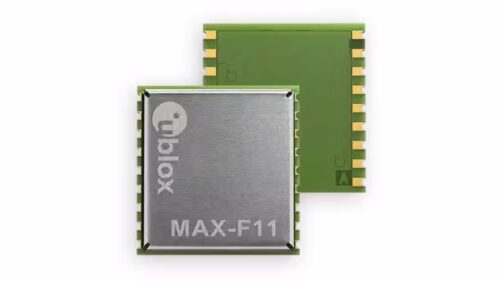
The u-blox has developed the F11 GNSS product line, which comprises ultra-low-power chips, modules, and an evaluation kit for reducing GNSS power requirements while preserving positioning accuracy. This solution is based on an innovative Selective L5 function that turns on the L5 frequency band when it provides a measurable benefit. This solution reduces the power consumption of devices by up to 50 per cent compared with continuous dual-band operation while maintaining metre-level positioning accuracy. The products have been launched as engineering samples, with additional models expected later this year.
The product line comprises dual-band UBX-F11270-KB and UBX-F11170-CC GNSS chips and the EVK-F112 evaluation kit. It also features the L1-only UBX-M11070-KB chip and MAX-M11N module for cases where dual-band reception is unnecessary. Typical power consumption drops to 7 mW in Low Energy Accurate Positioning (LEAP) mode.
Contrary to traditional dual-band GNSS receivers that continuously track both L1 and L5. The F11 platform monitors surrounding signal conditions and automatically switches to dual-band operation in challenging environments such as urban canyons, forests or areas experiencing severe multipath effects. It stays in the lower-power L1 mode during clear-sky conditions.
It is based on SPG 7.00 firmware, which offers additional features like polygonal geofencing, indoor detection, multipath mitigation, detection of jamming and spoofing, authenticated GNSS support and firmware updates through the host interface or over-the-air. Receivers can be configured and evaluated by u-center 2 software running on Windows. EVK-F112 evaluation kit allows fast prototyping and measuring power consumption.

The target applications include wearables, drones, aftermarket telematics, micromobility, assets tracking, livestock and pet monitoring. According to u-blox, shaving tens of milliwatts from every location fix can significantly extend battery life in applications requiring only occasional position updates.
Click here for the original announcement.