




KAIST researchers have developed an embedded liquid-cooling architecture that improves chip cooling efficiency tenfold, enabling AI processors and high-performance electronics to handle extreme heat with significantly lower energy consumption.
As artificial intelligence processors push computing performance to new levels, thermal management is emerging as one of the biggest barriers to future electronics. Researchers at KAIST have now unveiled a semiconductor cooling technology that could dramatically reduce the energy required to keep next-generation AI chips operating safely.
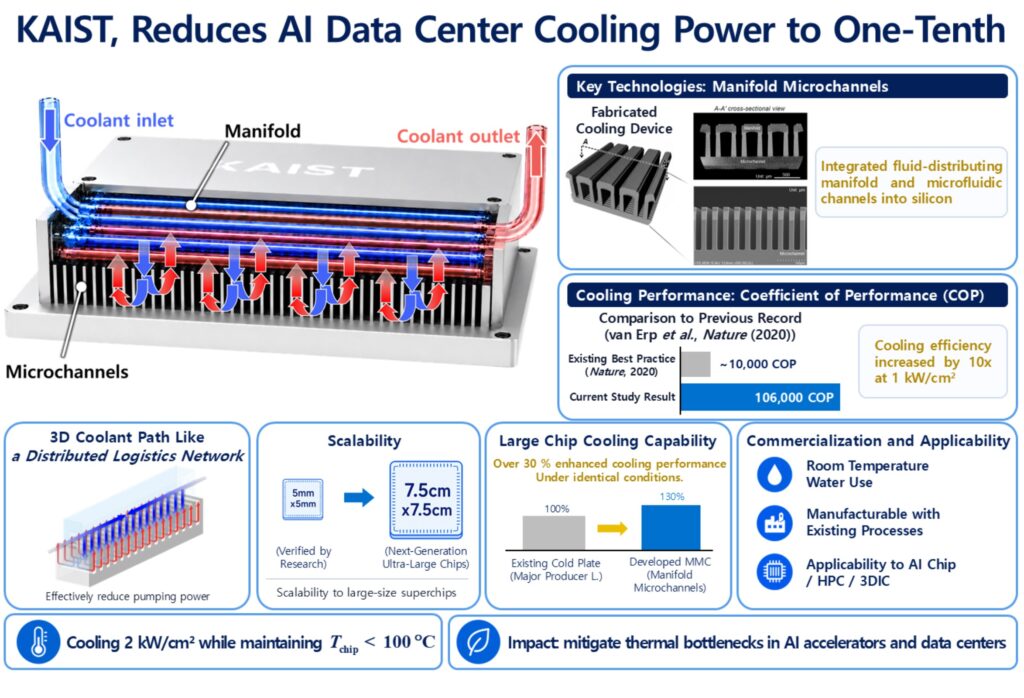
The research team developed an advanced liquid-cooling system that embeds microscopic water channels directly inside silicon chips. Unlike conventional air-cooling systems or external heat spreaders, the new approach removes heat at its source, allowing chips to sustain extreme power densities while maintaining stable operating temperatures. During testing, the technology kept chip temperatures below 100°C under heat loads exceeding 2,000 watts per square centimeter, a level associated with advanced AI accelerators and high-performance computing systems.
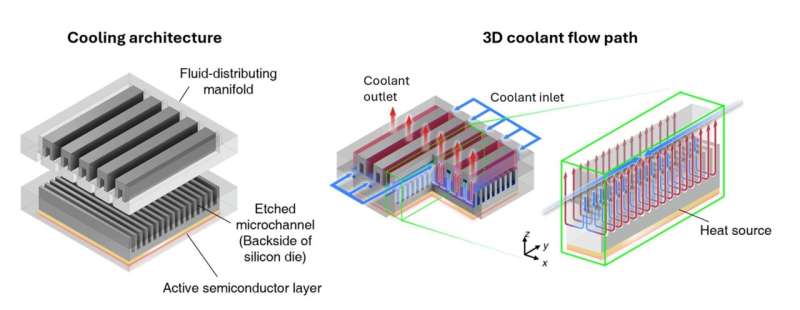
At the core of the breakthrough is a manifold microchannel architecture. Traditional microchannel cooling designs force coolant to travel long distances through tiny passages, increasing flow resistance and pumping energy requirements. KAIST’s design distributes coolant through multiple inlet and outlet pathways, shortening travel distances and improving flow uniformity across the chip. This reduces hydraulic resistance while ensuring consistent cooling performance across hotspots.
The result is a coefficient of performance (COP) of 106,000, roughly ten times higher than previously reported benchmark results. In practical terms, the system requires only about one-tenth of the pumping power needed to remove an equivalent amount of heat. Such gains could significantly lower the cooling overhead of AI data centers, where thermal management consumes a growing share of total energy use.

Another notable advantage is manufacturability. The cooling structure uses ordinary room-temperature water rather than specialised coolants and avoids costly materials such as diamond. It is also fabricated using a process below 350°C, making it compatible with existing semiconductor manufacturing infrastructure and potentially easier to integrate into commercial chip production.
The technology could find applications beyond AI processors, including high-performance computing platforms, 3D semiconductor packaging, power electronics and defense systems. As chipmakers continue to increase transistor density and computing power, embedded liquid cooling may become a critical enabler for future electronic systems that are increasingly constrained by heat rather than processing capability.


