

Researchers have developed a soft robotic glove that combines pneumatic actuators, muscle signals and machine learning to restore hand movement and improve everyday independence.
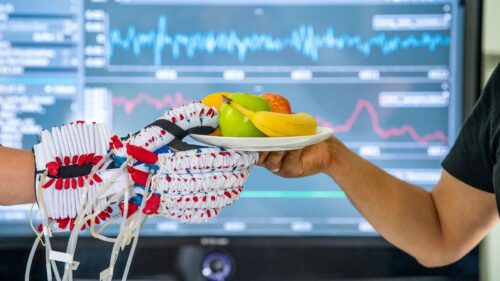
Researchers at the Technical University of Munich (TUM) have developed the Soft-Hand Exoskeleton, a wearable robotic glove designed to help people with paralysed hands regain the ability to grasp and hold everyday objects. The lightweight device combines pneumatic actuation, electromyography (EMG) muscle sensing and machine learning to detect a user’s movement intentions and provide real-time assistance. By supporting natural finger and wrist movements, the glove aims to improve independence in everyday activities such as eating, drinking and handling household items.
The Soft-Hand Exoskeleton differs from conventional rigid robotic exoskeletons by using a lightweight fabric glove fitted with inflatable air chambers. The wearable incorporates 13 pneumatic actuators positioned along the fingers and wrist, allowing each finger to move independently. By precisely controlling air pressure within these chambers, the glove assists users in bending, straightening and rotating their fingers and wrist with minimal effort, providing a secure grip on common household objects.
To recognise the wearer’s intended movements, the system continuously monitors electrical signals generated by the forearm muscles using electromyography (EMG) sensors. Machine learning algorithms analyse these signals in real time and activate the appropriate pneumatic chambers before the user completes the movement. Additional motion sensors monitor grip stability and automatically adjust assistance while objects are being carried, helping prevent accidental slips and improving safety.
Researchers believe the soft design makes the wearable more comfortable for extended use than rigid exoskeletons while delivering precise, targeted support only when required. The glove enables users to securely hold items such as cups, plates, cutlery and other everyday objects without restricting natural movement. The team expects the technology to support rehabilitation as well as long-term assistive care, with future work focusing on improving responsiveness, refining the control algorithms and evaluating the system in broader clinical and home environments.