How do you protect ultra fast data lines without slowing them down, when even tiny electrical noise can distort signals and break communication reliability?
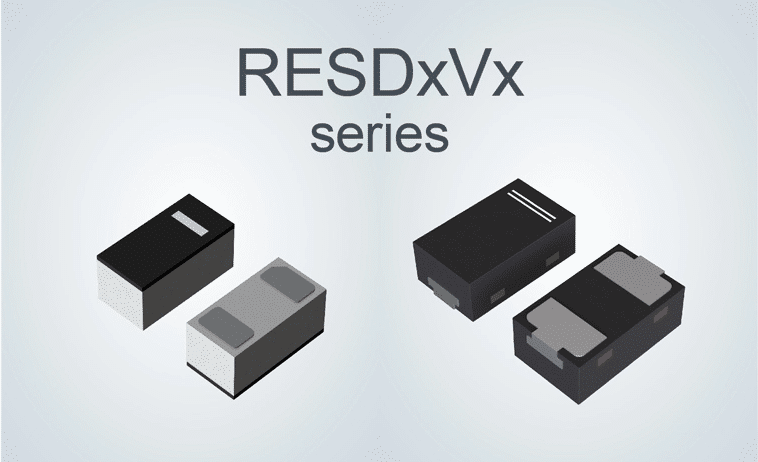
ROHM Semiconductor has introduced the RESDxVx series of Electro Static Discharge protection diodes, developed to support high speed communication interfaces operating beyond 10 Gbps. The launch comes at a time when modern electronics, from AI servers to automotive systems, are pushing signal integrity requirements to unprecedented levels while simultaneously shrinking device dimensions and increasing circuit density.
In high speed communication systems, maintaining clean signal transmission has become increasingly difficult. Interfaces such as USB4, Thunderbolt 4, PCI Express, HDMI, DisplayPort, automotive Ethernet, and SerDes architectures are particularly sensitive to parasitic capacitance, where even marginal interference can distort waveforms and compromise performance. At the same time, next generation ICs are becoming more vulnerable to electrostatic discharge and electrical overstress due to continued miniaturization.
The protection diodes are designed to address this growing conflict between signal integrity and circuit protection. According to the company, the series achieves terminal capacitance values as low as 0.24 pF in bidirectional configurations while reducing dynamic resistance to 0.28 Ω. This combination reportedly lowers clamping voltage by nearly 40% compared to conventional alternatives, enabling stronger IC protection without significantly affecting high speed signal quality.
One of the major advantages of the series lies in its broad deployment potential across emerging computing and communication infrastructure. The devices are positioned for use in AI servers, data centers, optical transceivers, 5G and 6G base stations, factory automation systems, and high performance consumer electronics including gaming consoles, laptops, smartphones, and AV equipment. Selected variants are also qualified for automotive applications such as Advanced Driver Assistance Systems, autonomous driving cameras, infotainment platforms, and in vehicle control units where stable multi gigabit communication is becoming increasingly critical.

As data rates continue climbing across industrial, consumer, and automotive electronics, balancing high speed communication with reliable electrical protection is rapidly becoming one of the defining engineering challenges of next generation hardware design.
Click here for the official announcement.