

A new miniature dual-band GNSS antenna combines L1/L5 support, compact packaging, and circular polarization to improve positioning accuracy for robotics, UAVs, telematics, and industrial IoT applications.
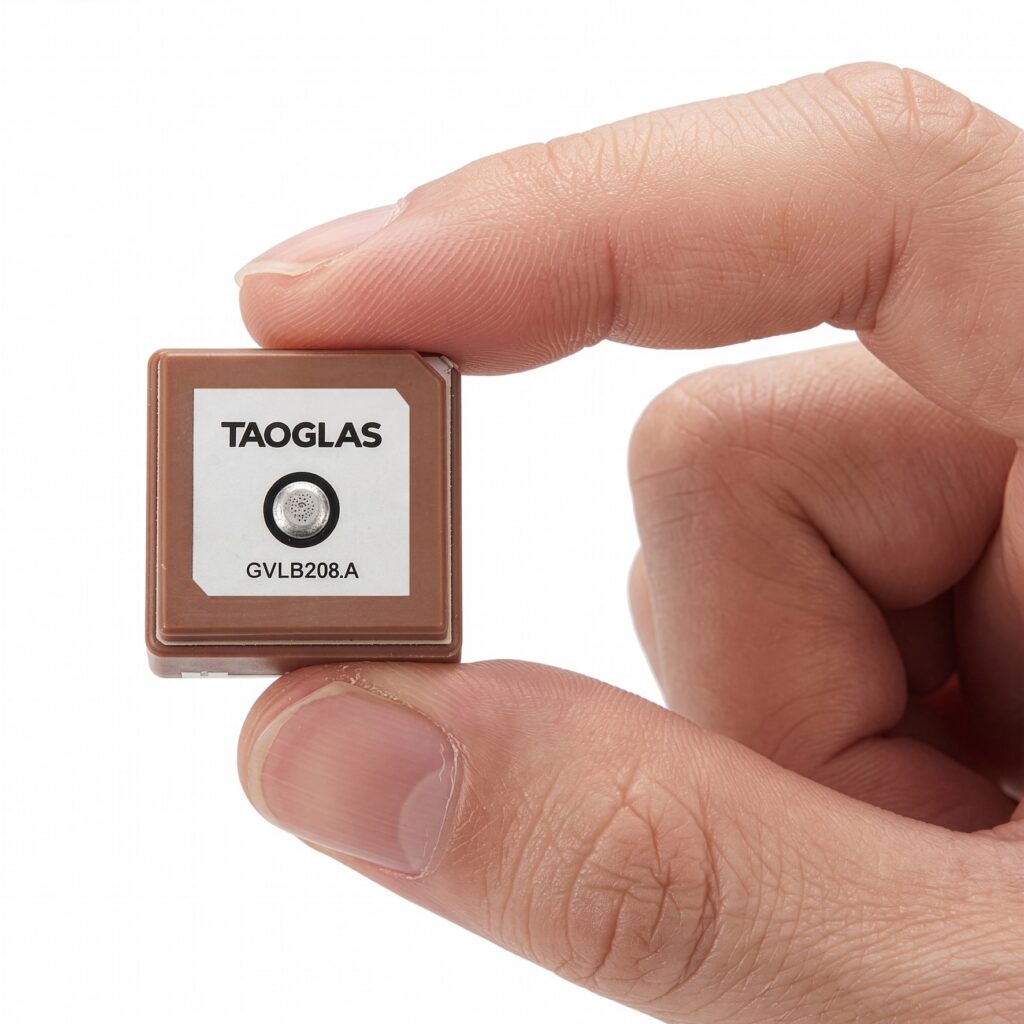
A newly launched ultra-compact dual-band GNSS antenna by Taoglas aims to address a growing challenge in positioning systems—achieving high accuracy without increasing device size. Designed in a 20 × 20 × 8 mm footprint, the antenna integrates simultaneous L1 and L5 band support in a compact architecture intended for applications where every millimetre of board space matters.
The product uses a single-feed stacked patch design to support concurrent L1/L5 operation, reducing design complexity compared with traditional multi-feed implementations. Dual-band capability also helps lower multipath interference effects, improving signal integrity and enabling more reliable high-precision positioning in dense or RF-challenging environments.
The key features are:
- Dual-band concurrent GNSS support (L1/L5)
- Single-feed stacked patch architecture
- Peak gain up to 1.5 dBi with ~50% efficiency
- Supports GPS, Galileo, GLONASS, and BeiDou constellations
Despite its small footprint, the antenna delivers performance levels typically associated with larger GNSS patch antennas. It achieves peak gain of up to 1.5 dBi with approximately 50% efficiency across both operating bands. Stable right-hand circular polarization (RHCP), enabled through an axial ratio of around 4 dB, supports consistent satellite signal reception and positioning performance.
The design is optimized for multiple global navigation constellations, including GPS, Galileo, GLONASS, and BeiDou, helping improve availability and positioning reliability across diverse operating conditions.
The passive version uses a pin-mount configuration that simplifies integration into standard PCB layouts and achieves optimum performance with a 70 × 70 mm ground plane. An active variant integrates filtering electronics and includes a micro-coax cable and compact connector interface to simplify integration with multiband GNSS modules.
The compact antenna family is intended for positioning-intensive applications such as autonomous delivery robots, unmanned aerial vehicles (UAVs), telematics systems, fleet and asset tracking, precision agriculture, and industrial IoT systems. The company also plans to expand the range with a surface-mount version targeted at high-volume automated manufacturing environments.
Click here for the original announcement.