As wearables shrink beyond cables and coils, the wireless approach is reshaping how power is delivered to the smallest devices.
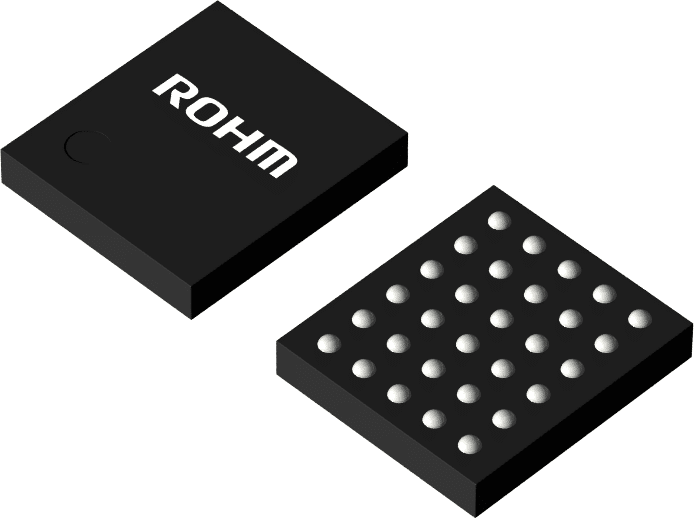
ROHM has introduced a wireless power supply chipset designed for compact wearable devices, combining the ML7670 receiver and ML7671 transmitter with support for Near Field Communication based charging.
The chipset addresses a growing challenge in ultra small wearables such as smart rings and bands, where traditional wired charging is impractical and conventional Qi wireless charging is difficult to implement due to coil size limitations. By operating at 13.56 MHz, the solution enables smaller antenna designs while supporting proximity based power transfer, aligning with emerging requirements in next generation wearable form factors.
The chipset is designed to reduce system complexity and improve integration efficiency. Built-in switching MOSFETs eliminate the need for additional external components, while embedded firmware removes the requirement for a host microcontroller. This combination helps reduce board space and development effort, which are critical factors in highly constrained wearable designs. Compliance with NFC Forum WLC 2.0 also allows compatibility with existing NFC ecosystems, supporting broader adoption.
The receiver IC delivers up to 250 mW of power with a maximum transfer efficiency of 45 percent in low output conditions. It is packaged in a compact 2.28 × 2.56 × 0.48 mm form factor, targeting space constrained applications. Performance improvements are achieved through optimizations in coil matching, rectifier design and switching losses. The chipset is already in mass production and has been adopted in devices such as the SOXAI Ring 2, a sleep monitoring smart ring.

The development reflects a wider shift toward NFC based wireless power as an alternative to conventional charging methods in ultra compact electronics. As wearable devices continue to shrink, solutions that combine miniaturization with efficient power delivery are likely to play a key role in enabling new device categories and use cases.
Click here for the official announcement.