




HomeElectronics NewsHydrogen Production Using Organic Semiconductors

Hydrogen Production Using Organic Semiconductors

UNIST researchers revolutionise green hydrogen production, enhancing photoelectrode efficiency and stability with organic semiconductors, steering towards a carbon-neutral future.
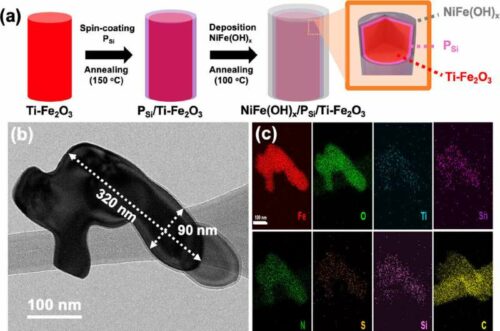
(a) Scheme for the fabrication of NiFe(OH)x/PSi/Ti–Fe2O3. (b) Transmission electron microscopy (TEM) image of NiFe(OH)x/PSi/Ti–Fe2O3 and (c) corresponding elemental mapping of Fe, O, Ti, Sn, N, S, Si, and C. High-resolution TEM images of (d) PSi/Ti–Fe2O3 and (e) NiFe(OH)x/PSi/Ti–Fe2O3. The inset in panel d shows a high-resolution TEM image of Ti–Fe2O3, and the scale bar is 2 nm. Credit: ACS Energy Letters (2023). DOI: 10.1021/acsenergylett.3c00755
(a) Scheme for the fabrication of NiFe(OH)x/PSi/Ti–Fe2O3. (b) Transmission electron microscopy (TEM) image of NiFe(OH)x/PSi/Ti–Fe2O3 and (c) corresponding elemental mapping of Fe, O, Ti, Sn, N, S, Si, and C. High-resolution TEM images of (d) PSi/Ti–Fe2O3 and (e) NiFe(OH)x/PSi/Ti–Fe2O3. The inset in panel d shows a high-resolution TEM image of Ti–Fe2O3, and the scale bar is 2 nm. Credit: ACS Energy Letters (2023). DOI: 10.1021/acsenergylett.3c00755

Utilising solar energy for green hydrogen production involves breaking water down into its essential elements through charges generated in semiconductors that capture sunlight. While most previous studies have centred on inorganic semiconductors for photoelectrode construction, organic semiconductors present a promising alternative due to their lower costs, varied processing methods, and ease of large-scale production. Moreover, their high solar energy conversion efficiency potentially boosts hydrogen production efficiency, although their susceptibility to water damage has hindered their widespread application in photoelectrodes.

- Advertisement -

Researchers from the School of Energy and Chemical Engineering at Ulsan National Institute of Science and Technology (UNIST) have achieved a significant breakthrough in photoelectrode development. The team have successfully created a robust and high-performance photoelectrode by integrating organic semiconductors as an intermediary layer within the existing inorganic semiconductor-based photoelectrodes.

The team managed to enhance the stability of conventional iron oxide-based photoelectrodes when exposed to water by applying a coating of organic semiconductors onto their surface. Further safeguarding the setup, they introduced a catalyst composed of a nickel/iron double-layer hydroxide as an added protective layer over the organic semiconductor coating, preventing its direct contact with water. This groundbreaking strategy enabled the charges created from solar energy absorption to catalyse hydrogen production reactions effectively.

By addressing the drawbacks of conventional inorganic semiconductor-oriented photoelectrodes, the team have showcased the potential for more extensive integration of organic semiconductors in hydrogen production processes facilitated by photoelectrodes. This milestone paves the way for heightened efficiency and stability and fosters the progression of sustainable energy solutions, steering us towards a carbon-neutral future.

- Advertisement -

Reference: Hyo-Jin Ahn et al, Utilizing a Siloxane-Modified Organic Semiconductor for Photoelectrochemical Water Splitting, ACS Energy Letters (2023). DOI: 10.1021/acsenergylett.3c00755

Nidhi Agarwal
Nidhi Agarwal
Nidhi Agarwal is a Senior Technology Journalist at Electronics For You, specialising in embedded systems, development boards, and IoT cloud solutions. With a Master’s degree in Signal Processing, she combines strong technical knowledge with hands-on industry experience to deliver clear, insightful, and application-focused content. Nidhi began her career in engineering roles, working as a Product Engineer at Makerdemy, where she gained practical exposure to IoT systems, development platforms, and real-world implementation challenges. She has also worked as an IoT intern and robotics developer, building a solid foundation in hardware-software integration and emerging technologies. Before transitioning fully into technology journalism, she spent several years in academia as an Assistant Professor and Lecturer, teaching electronics and related subjects. This background reflects in her writing, which is structured, easy to understand, and highly educational for both students and professionals. At Electronics For You, Nidhi covers a wide range of topics including embedded development, cloud-connected devices, and next-generation electronics platforms. Her work focuses on simplifying complex technologies while maintaining technical accuracy, helping engineers, developers, and learners stay updated in a rapidly evolving ecosystem.

SHARE YOUR THOUGHTS & COMMENTS

EFY Prime

Unique DIY Projects

Electronics News

Truly Innovative Electronics

Latest DIY Videos

Electronics Components

Electronics Jobs

Calculators For Electronics