Researchers creates a low-loss and high-dielectric elastomers material for smart wearable electronics.
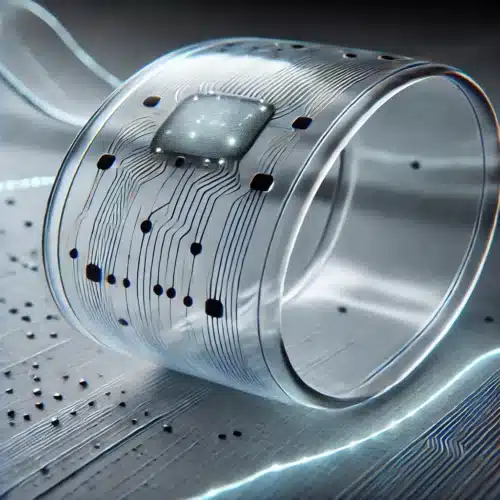
A research team led by Professor Hu Benlin, Ningbo Institute of Materials Technology and Engineering (NIMTE), China has developed an elastomer with a high dielectric constant and minimal dielectric loss. This new material is poised to significantly enhance the performance and reliability of smart wearables by combining ferroelectricity with elasticity. The study demonstrates the elastomer’s potential in upgrading wearable technology.
The development of this novel approach minimises energy loss while maximising dielectric properties. Earlier efforts by Hu’s team introduced soft long-chain crosslinking in ferroelectric polymers, achieving an elastomer with a high dielectric constant. However, this structure often led to high dielectric loss due to energy dissipation from the chains’ movement under electric fields. This limitation has hindered the full potential of such elastomers in wearable applications, especially for manufacturers of flexible electronics, sensor systems, and energy-harvesting devices.
In their latest study, the team addressed this challenge by incorporating a rigid short-chain crosslinker with the relaxor ferroelectric P(VDF-TrFE-CFE), an innovative change that resulted in a high dielectric constant of approximately 35 at 1kHz and a substantially reduced dielectric loss of about 0.09. This reduction marks an over 70% decrease in dielectric loss compared to the previous long-chain crosslinking method, making it an attractive option for developers working on advanced wearable devices, smart health monitors, and flexible sensor technologies.
The elastomer’s design not only improves electrical properties but also enhances physical resilience, achieving a high elastic recovery ratio exceeding 70% even under 60% strain. Devices crafted with this elastomer demonstrated stable ferroelectric responses and retained their unique relaxor properties under 80% strain, highlighting their suitability for flexible electronics.
The findings from NIMTE’s study open new opportunities for high-dielectric elastomers across various applications beyond wearables, including actuation, sensing, information processing, and energy storage. The material’s balance of high dielectric performance, elasticity, and low energy loss positions it as a cornerstone for future advancements in the wearable technology sector.