


What is Gujarat State Electronics Mission (GSEM), and how is it attracting major investments in electronics manufacturing, particularly semiconductor manufacturing, to Gujarat? To delve deeper, Electronics For You’s Nijhum Rudra spoke with Manish Gurwani, the head of GSEM. Here is what he revealed…
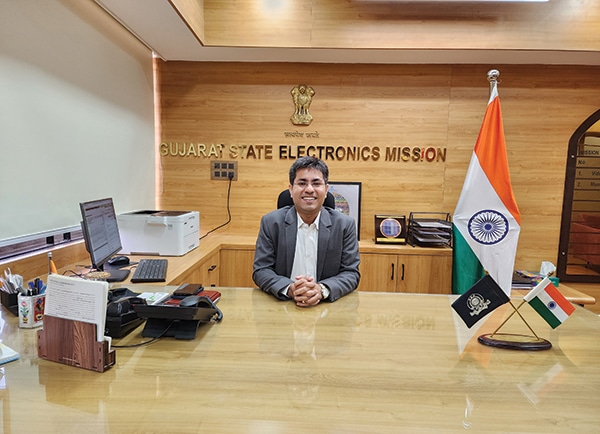
Q. As the mission director, what industry activities and initiatives keep you engaged?
A. I have the privilege of leading a truly transformative initiative with the Gujarat State Electronics Mission (GSEM), whose scope and responsibilities make it a pioneering body in India’s semiconductor and electronics industry. GSEM adopts an umbrella-body approach, integrating policy formulation, investment promotion, investor facilitation, approval processing, and incentive disbursal. It is one of India’s very few state bodies to manage the entire lifecycle of the electronics ecosystem—from approvals to subsidies. We have secured four out of the five India Semiconductor Mission (ISM) projects in Gujarat. GSEM provides a one-stop solution for policy, approvals, and subsidies, ensuring a seamless experience from planning to execution.

Q. Can you paint an overall picture of the impediments to growing the ESDM and semiconductor ecosystem in the state? How are you tackling the hurdles?
A. Robust infrastructure is a critical enabler for the semiconductor and electronics industries, and Gujarat’s focus on continuous review and enhancement is commendable. Our project-monitoring component ensures challenges are identified and addressed early, maintaining investor confidence and project timelines.
On the skilling side, a Centre of Excellence at Pandit Deendayal Energy University (PDEU), through a tripartite collaboration involving the Department of Science and Technology (DST-GSEM), Micron, and PDEU, is an excellent start. Establishing additional Centres of Excellence across other regions of Gujarat will create distributed talent pools.
We encourage long-term partnerships, such as internships, apprenticeships, and research and development collaborations, to enhance Gujarat’s talent pipeline.

Q. You have separate ESDM and semiconductor policies. What is unique about Gujarat’s electronics and semiconductor policies compared to those of other states?
A. Our semiconductor policy is specifically tailored to projects approved under the India Semiconductor Mission (ISM). As an umbrella scheme, the electronics policy encompasses industries across the electronics system design and manufacturing (ESDM) spectrum.
There are no immediate plans for merging or modifying the policies; however, the state remains open to feedback from industry and academia. Acknowledging feedback as valuable input reflects a collaborative ethos and further strengthens the policies, aligning them with real-world challenges and opportunities.
Q. What is the total land allotted to electronics and chip investors in the past few years? What is the total capex and subsidies offered to the industry?
A. Under the Gujarat Semiconductor Policy 2022-27, only projects approved under the ISM scheme are eligible for subsidies. Gujarat relies on ISM’s scrutiny process and does not conduct additional scrutiny at the state level, reducing the industry’s burden.
We approved an $11 billion Tata Electronics project with Powerchip Semiconductor Manufacturing Corporation (PSMC), Taiwan, in less than 24 hours at the state government level.
Regarding capital subsidy, Gujarat contributes 40 percent of the government of India’s subsidy amount on capital expenditure (CapEx). Our policy’s uniqueness lies in subsidising the first 80 hectares (200 acres) for semiconductor fab projects at 75 percent. Power and water are provided at highly competitive rates, with water priced at ₹12 per cubic metre for five years from COD, increasing by 10 percent annually for the subsequent five years.
Q. What are Gujarat’s most prominent differentiating aspects attracting major semiconductor investments?
A. Gujarat was the first state in India to launch a semiconductor policy, demonstrating proactive governance and forward-thinking leadership.
The state boasts reliable water and power networks, disburses subsidies promptly, and implements well-structured policies free from bureaucratic delays.
Q. Out of the state’s total 196,024km² of areas, why are Sanand and Dholera the most preferred semiconductor destinations? Which other areas are targeted for investments in the industry?
A. Dholera has been declared a Semicon City by the Gujarat government, serving as a dedicated area for semiconductor and electronics manufacturing.
It offers world-class infrastructure, a common effluent treatment plant (CETP), and sewage treatment plants (STPs). Uninterrupted power supply and water resources address the industry’s high-tech demands.
The Ahmedabad-Dholera Expressway and the upcoming dedicated airport will enhance connectivity.
Q. What would be the additional employment in the coming years? Any numbers you would like to share?
A. Out of the total committed investments of ₹1.24 lakh crore ($15 billion) in the semiconductor sector in Gujarat, approximately 53,000 jobs will be created—both direct and indirect. This includes high-skilled technical roles and support functions across the value chain.
To view the full video: click here