




A method to make quantum dots lets them release single photons. The approach could support quantum communication systems and photonic quantum computing.
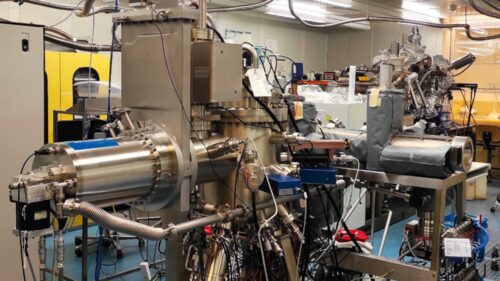
Scientists from the Gleb Wataghin Physics Institute of the State University of Campinas in Brazil developed a way to manufacture semiconductor quantum dots that emit single photons. The step could support quantum communication and photonic quantum computing. The team used a fabrication technique called local droplet etching to create quantum dots with lower density and symmetry, allowing stable single-photon emission.
Quantum dots are nanoscale semiconductor structures that confine electrons and holes. When excited by a laser, they emit light at wavelengths. Because they can release individual photons or entangled photon pairs, they are components for quantum technologies such as communication systems and photonic quantum processors.
Many experiments rely on indium gallium arsenide quantum dots produced through the Stranski–Krastanov growth method. In this process, one crystal layer grows on another according to the lattice structure of the substrate. The technique often produces quantum dots with surface density and structural variation, making it difficult to isolate photon emitters. The dots also show radiative lifetimes of about one nanosecond and leave a wetting layer that can introduce electronic effects.
To address these issues, the researchers used local droplet etching during crystal growth. Metal droplets form on the surface and create nanocavities. These cavities are then filled in a controlled way to produce quantum dots with adjustable density.
The nanocavities were filled with a thin layer of indium gallium arsenide, about one nanometer thick. This reduced strain and improved optical behavior. Measurements showed a surface density of around 0.2 to 0.3 quantum dots per square micrometer, making it easier to isolate emitters.
The structures also produced faster photon emission. Radiative lifetimes were measured at about 300 picoseconds, about three times shorter than quantum dots produced using conventional growth methods.
Researchers also adjusted the indium concentration to control the wavelength of emitted light. Emission could be tuned between about 780 and 900 nanometers at cryogenic temperatures, a range used in photonic systems.
The team also examined fine structure splitting, a parameter that determines whether quantum dots can generate polarization-entangled photon pairs. The values measured were comparable to results reported in similar systems, indicating use in quantum cryptography and quantum networks.


