


Blending lithium and sodium ions, researchers in Ireland have created a dual-cation battery that doubles capacity, boosts stability, and sets a new benchmark for sustainable energy technology.
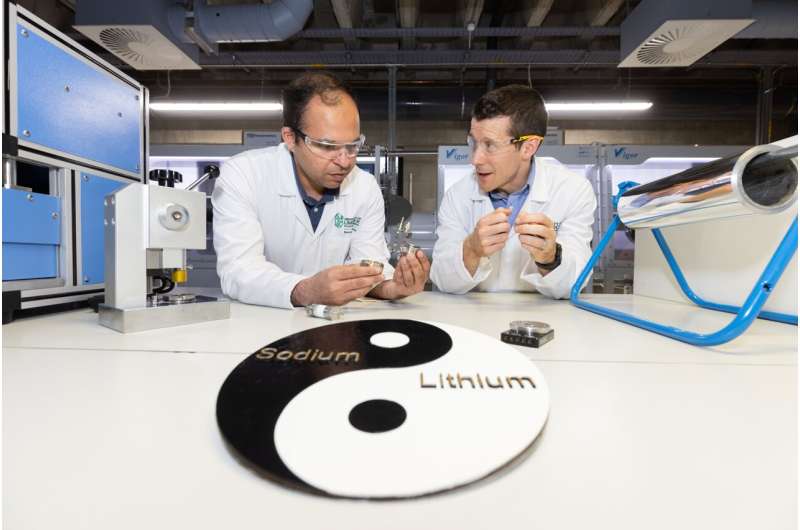
In an advancement that could reshape the future of electric mobility and portable electronics, researchers in Ireland have unveiled the world’s first full-cell dual-cation battery—a system that harnesses the combined power of lithium and sodium ions to achieve superior energy density and long-term stability.
Developed at the University of Limerick’s Bernal Institute, the innovation merges the high performance of lithium-ion chemistry with the cost efficiency and sustainability of sodium-ion systems. Reported in Nano Energy, the study was led by Associate Professor Hugh Geaney and Dr. Syed Abdul Ahad, in collaboration with the University of Birmingham.
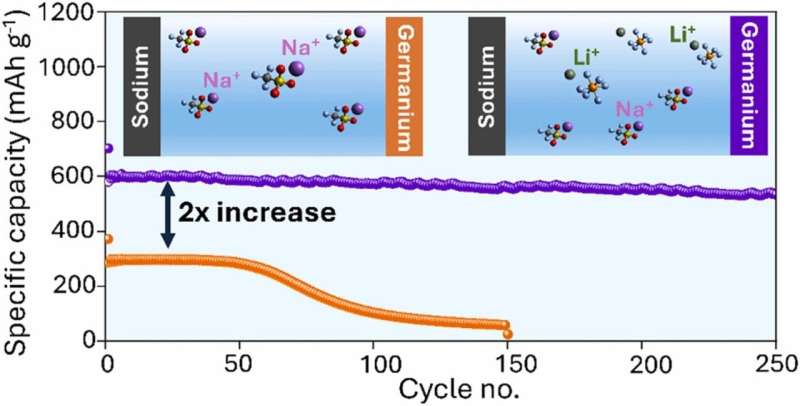
Traditional sodium-ion batteries, while cheaper and more environmentally friendly than lithium-ion, typically suffer from low capacity and poor energy density. The new dual-cation design resolves this limitation by introducing lithium ions as a “capacity booster” within a sodium-dominant electrolyte. This hybrid approach enables the battery to store nearly double the charge compared to conventional sodium-ion cells.
“For the first time, we’ve demonstrated that sodium-ion systems can be supercharged using a lithium-sodium pairing,” said Geaney. “It’s a significant step toward sustainable, high-performance energy storage.”
The researchers found that the lithium ions act synergistically with sodium during charge and discharge cycles, improving both energy output and stability. Early tests show the cell can withstand up to 1,000 cycles, a crucial threshold for commercial viability.Beyond performance, the design’s environmental and economic implications are profound. By minimizing the dependence on scarce and costly materials like cobalt, the technology offers a greener, scalable route for electric vehicles and grid storage applications.
Looking ahead, the UL team plans to expand its research to silicon-based anodes and explore alternative ion combinations such as lithium–magnesium and potassium–lithium systems—paving the way for the next generation of versatile, sustainable batteries.