




Cars are getting more advanced. One sensor can track two positions at once, make systems simpler, and give accurate steering and torque control.
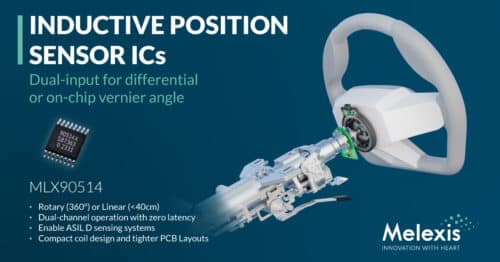
Automotive systems are becoming more complex due to electrification, autonomy, and advanced driver-assistance systems (ADAS), increasing the need for dual-channel position sensing to deliver accurate torque and angle measurements. Traditionally, this required combining two single-channel ICs or using magnetic sensors, but these approaches can add cost and complexity.
The MLX90514 from Melexis addresses these challenges by integrating differential and vernier angle calculations on-chip, reducing host processing requirements and enabling smaller, simpler sensor designs. It reads two sets of coils simultaneously to compute differential or vernier angles, making it particularly suited for next-generation automotive applications such as steering torque feedback, steering angle sensing, and steering rack motor control, including steer-by-wire systems.
As Melexis’ first dual inductive application-specific standard product (ASSP), the IC supports multiple interface options: SENT, SPC, and PWM for standalone modules, and SPI for embedded modules. It computes complex position information directly on the sensor, eliminating the need for multiple ICs and reducing bill-of-material count. SENT/SPC output can carry up to 24-bit payload, delivering two synchronized 12-bit channels for high-accuracy torque and angle sensing.
Key features of the sensor IC include zero-latency synchronized dual-channel operation for real-time, precise position sensing in critical automotive systems; external PWM signal integration for reading signals from magnetic sensors to process multi-turn angle and torque in a single IC; compact coil support and tight PCB layouts to enable smaller, highly integrated modules without performance loss; and ASIL D compliant sensing, supporting Safety Element out of Context (SEooC) systems for steering torque and angle applications, meeting the highest functional safety standards.

