

A new class of military-qualified transient voltage suppressors brings plastic packaging into aerospace and defense designs, combining high surge protection with lower weight and cost.
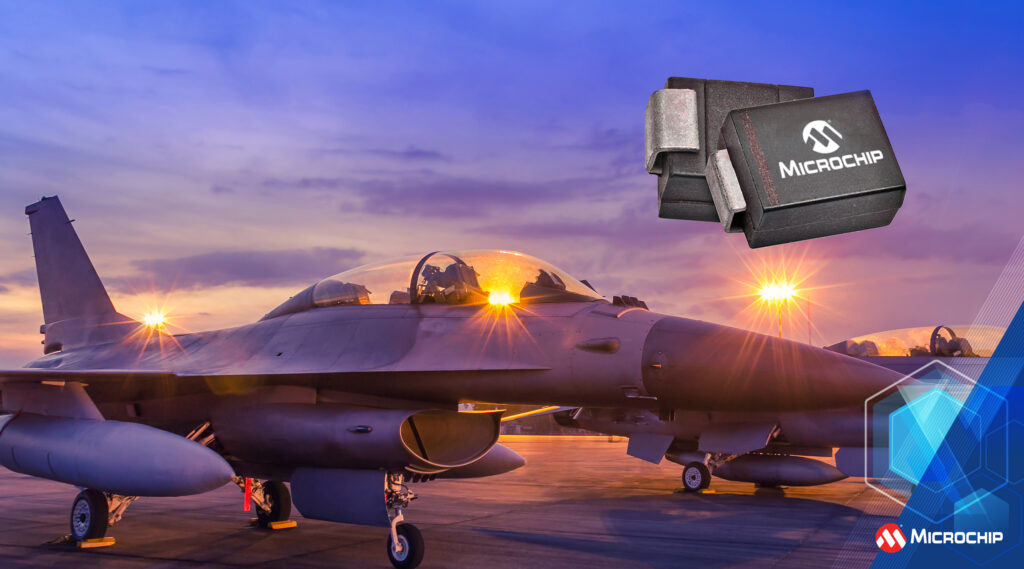
Military and aerospace system designers now have access to a lighter, surface-mount transient voltage suppression option that meets stringent defense qualification requirements without relying on traditional hermetic packaging. A newly introduced family of plastic transient voltage suppressor (TVS) devices by Microchip Technology achieves compliance with MIL-PRF-19500, marking a first for non-hermetic plastic packages in this qualification class.
The devices are rated for a peak pulse power of up to 1.5 kW (10/1000 µs), enabling robust protection of sensitive electronics against high-energy voltage transients. With response times measured at under 100 picoseconds, the TVS family is designed to clamp fast-rising events such as electrostatic discharge, switching transients, induced RF effects, electromagnetic pulse (EMP), and secondary lightning strikes—common threats in airborne and defense platforms.
The key features are:
- 1.5 kW peak pulse power rating
- Sub-100 ps transient response time
- Wide working voltage range (5 V–175 V)
- Surface-mount, unidirectional protection
Available across a wide working voltage range from 5 V to 175 V, the TVS lineup targets low-voltage and mixed-signal circuits used in avionics, mission electronics, power distribution units, and control systems. The surface-mount, unidirectional design supports modern high-density PCB layouts, while the lightweight construction—around 0.25 g per device—helps reduce overall system mass, a critical factor in aerospace applications.
In addition to military qualification, the devices are designed to support compliance with IEC 61000-4-2, IEC 61000-4-4, and IEC 61000-4-5 standards, simplifying electromagnetic compatibility (EMC) planning for engineers working on ruggedized systems. For designers requiring alternative form factors, equivalent hermetic package options remain available for both surface-mount and through-hole designs, allowing drop-in flexibility across platforms.
To accelerate adoption, the TVS family is supported by SPICE models that enable virtual simulation of transient behavior during the design phase, reducing the need for repeated physical prototyping. This is particularly relevant for aerospace and defense programs, where redesign cycles are costly and qualification timelines are long.
Overall, the move toward military-qualified plastic TVS devices reflects a broader shift in defense electronics toward lighter, more cost-efficient components—without compromising reliability in harsh operational environments.