




By switching from lithium to sodium, researchers open a scalable path for smart windows that cut solar heat using Earth abundant materials.
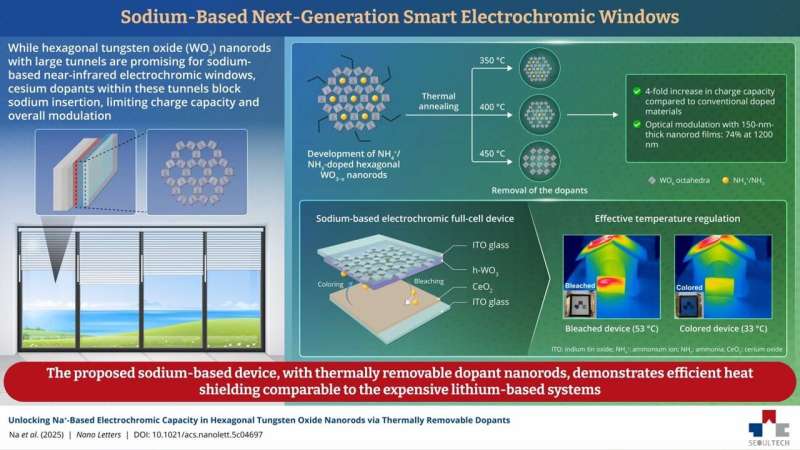
Thermal management in buildings increasingly depends on controlling near infrared radiation, which contributes significantly to solar heat gain. Existing electrochromic smart window systems rely heavily on lithium based materials that face cost, supply, and scalability constraints while limiting wider deployment.
Researchers at Seoul National University of Science and Technology have demonstrated sodium based electrochromic nanorods for smart window applications. The work shows that sodium ion systems can achieve near infrared heat blocking performance comparable to lithium based counterparts while using thinner electrochromic films.
The approach uses hexagonal tungsten oxide nanorods whose tunnel structures act as optically active sites for ion insertion. Thermally removable dopants are introduced during synthesis to stabilize the hexagonal phase and are later eliminated through heat treatment, clearing steric barriers for sodium ion insertion. This enables large near infrared modulation with sodium electrolytes in films as thin as 150 nm while maintaining electrochromic functionality.
Key features of the research include:
- Sodium ion compatible hexagonal tungsten oxide nanorods
- Thermally removable dopants to preserve tunnel accessibility
- Near infrared modulation comparable to lithium based systems
- Electrochromic film thickness of approximately 150 nm
- Single reactor batch synthesis with controlled temperature and pressure
- Colloidal form suitable for coating and composite processing
Professor Sungyeon Heo, who led this research work, says, “Our study demonstrates material designs and processing strategies that are compatible with low-cost, Earth-abundant components, such as sodium electrolyte, and scalable synthesis methods, such as a single reactor batch. Ultimately, our research supports a transition toward a more sustainable environment and could finally reduce energy demand in everyday life.”


