





The new wave-control surface separates elastic signals by frequency for smarter sensing and electronics.
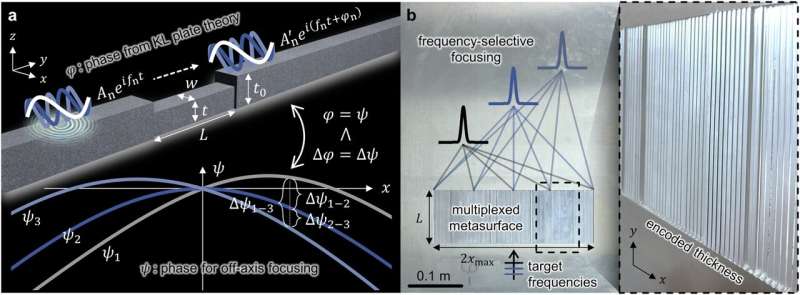
Researchers from POSTECH have developed a frequency-multiplexed elastic metasurface, a single engineered plate that can simultaneously distinguish and steer elastic waves at different frequencies into separate directions. This challenges the traditional constraint in wave-manipulating electronics and mechanical systems that devices can only operate effectively at one frequency at a time.
Elastic waves are mechanical vibrations that travel through materials and are widely used in non-destructive testing, structural monitoring, and sensing systems. Conventional technologies require separate structures or devices to handle different frequencies, since even small changes in frequency can alter wave speed and mode shapes, severely limiting performance and integration.
The team, led by researchers at POSTECH (Pohang University of Science and Technology) with collaborators from the Korea Research Institute of Standards and Science (KRISS), designed a thin elastic plate whose thickness profile is precisely engineered so that different elastic frequencies experience different phase responses as they propagate through it. This is analogous to how a prism splits light into a spectrum by bending different wavelengths at different angles.
In experiments, the metasurface could focus elastic waves at frequencies like 40 kHz, 60 kHz, and 80 kHz onto separate spatial locations. At these focal points, piezoelectric elements converted the focused vibrations into electrical signals and the signal at the targeted frequency was up to 48 times stronger than others. This demonstrates frequency-selective detection and routing within a single surface, without the need for multiple devices or complex external equipment.

Crucially for electronics and sensing applications, this integration of frequency separation, spatial routing, and signal conversion in one component could simplify designs and reduce costs in systems from industrial inspection rigs to embedded structural health monitors. Because the platform does not rely on extensive or active components, it promises a compact, passive solution for applications where multiple frequency channels must be distinguished and processed. The research represents a significant step in wave-control technologies for advanced sensing, structural electronics, and signal processing, by showing that elastic waves across multiple bands can be handled by a single engineered surface.


