A wireless system sends data at 25 Gbps over 10 kilometers using controlled light, without using fiber cables or licensed spectrum.
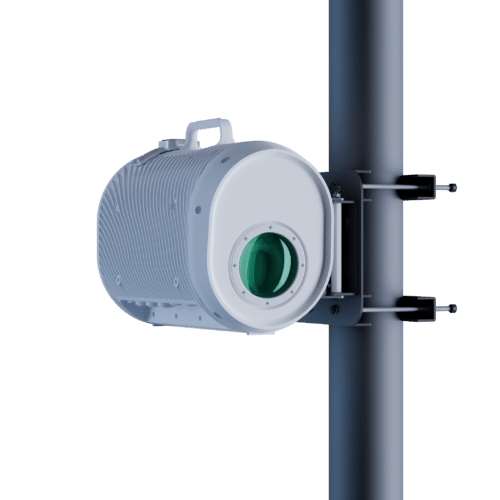
Taara has introduced a new wireless optical communication platform that delivers up to 25 Gbps over distances of 10 kilometers, without laying fiber or using licensed spectrum. The platform, called Taara Photonics, is built on proprietary optical phased arrays and is already integrated into its first product, Taara Beam.
Taara Beam is a compact, deployable unit that can be installed on rooftops, poles, or existing structures within hours. It is designed for operators, enterprises, data center clusters, campuses, and dense urban networks. The system creates high-bandwidth mesh links that support small-cell backhaul, fronthaul, and low-latency AI workloads. Because it operates in the unlicensed optical spectrum, it avoids spectrum congestion and recurring fees.
The core shift is architectural. Instead of steering light using mirrors and mechanical parts, Taara Beam controls light electronically. Traditional free-space optical systems depend on moving components to align beams. That works, but it becomes harder to scale and maintain.
Taara moves this function into an integrated photonic chip. At the center of Beam is a module with more than a thousand miniature light emitters arranged in an optical phased array. This solid-state design allows the system to steer, shape, and track light with electronic precision. Removing mechanical steering reduces complexity and size, while improving reliability and response time.
The underlying optical phased array technology was developed over several years at X, Google’s Moonshot Factory, where Taara originated. The company previously deployed an earlier system, Taara Lightbridge, which is active in more than 20 countries with operators including Airtel, Digicel, T-Mobile, SoftBank, and Liquid.
Taara Beam represents the next step. By condensing wireless optical communication into a shoebox-sized device, the company aims to make high-speed links faster to deploy, easier to scale, and simpler to upgrade over time. The goal is to build networks that can expand or adapt without the delays and cost associated with fiber rollout.