


By removing moisture earlier in the airflow path, a hybrid cooling system can reduce the load on traditional compressors while maintaining indoor comfort conditions.
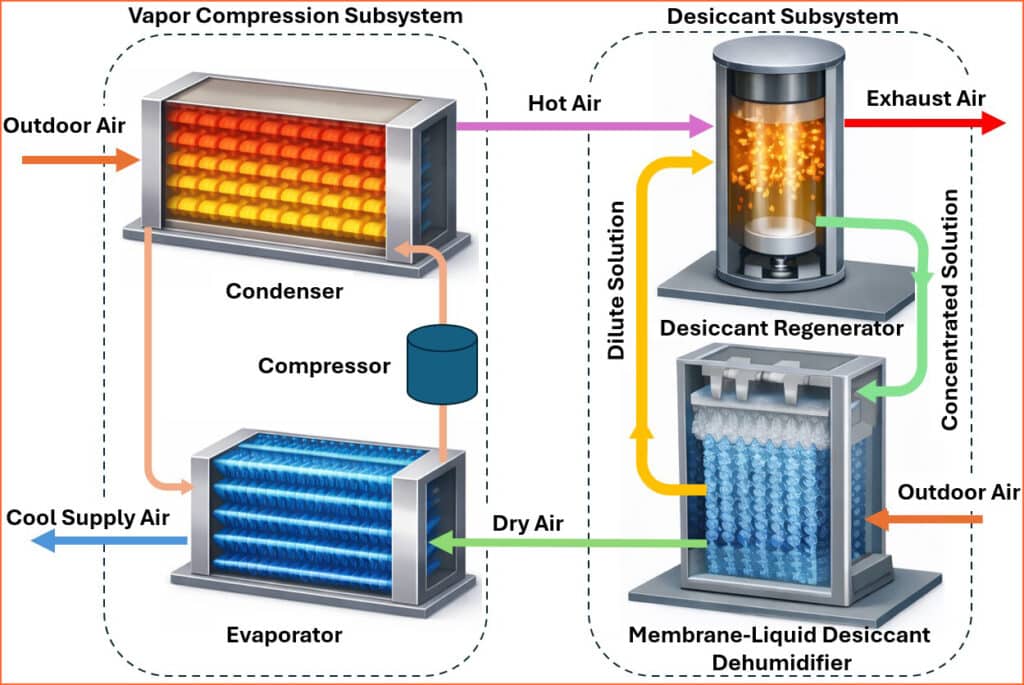
Researchers at Indian Institute of Technology Delhi are developing a hybrid air conditioning system designed to improve cooling efficiency while lowering electricity consumption. The laboratory scale prototype, created by a team from the Department of Mechanical Engineering integrates a membrane based liquid desiccant module with a conventional vapor compression air conditioning system to address humidity control more efficiently.

By reducing the need for excessive air cooling to remove humidity, the hybrid approach can lower the total electricity required to achieve indoor comfort conditions. In laboratory testing, the system reduced power consumption from around 1200 W for a typical room air conditioner to roughly 800 W while maintaining comparable comfort levels. Across representative Indian climate conditions, projected savings range from about 28 percent in humid regions to more than 40 percent in dry and arid environments.
Conventional vapor compression air conditioners remove moisture by overcooling air until water vapor condenses, an energy intensive process. In the hybrid configuration, moisture is removed earlier in the airflow path using a liquid desiccant, reducing the load on the cooling stage. The design also uses heat rejected by the condenser unit to regenerate the desiccant solution, improving energy utilization without the need for an additional heater.
The system incorporates a compact add on module that absorbs moisture from incoming air using a salt based liquid desiccant. A thin selective polymer membrane separates the air from the solution, allowing water vapor to pass while preventing the salt from entering the indoor airflow. After absorbing moisture, the diluted desiccant is routed through a regeneration module where waste heat from the condenser dries the solution and prepares it for reuse, forming a continuous closed loop process.
Prof. Anurag Goyal, Department of Mechanical Engineering, IIT Delhi says, “Using the proposed system at typical operating conditions, total electricity consumption decreased from approximately 1200 W for a standard room AC to about 800 W for the hybrid, resulting in around 33 percent lower energy consumption while meeting the same indoor comfort targets.”