Thermoradiative diode technology conceals electronic data signals within natural heat radiation, making transmissions nearly impossible to detect.
Engineers have developed a new electronic communication technique that can hide data transmissions within natural heat radiation, potentially enabling secure and nearly undetectable information exchange.Researchers from the University of New South Wales (UNSW) and Monash University demonstrated a system that exploits a phenomenon known as negative luminescence. Instead of emitting visible signals or detectable radio waves, the technology modulates mid-infrared radiation so that the data blends seamlessly with the background thermal energy emitted by objects. To outside observerseven those using thermal camerasthe transmission appears indistinguishable from normal heat radiation.
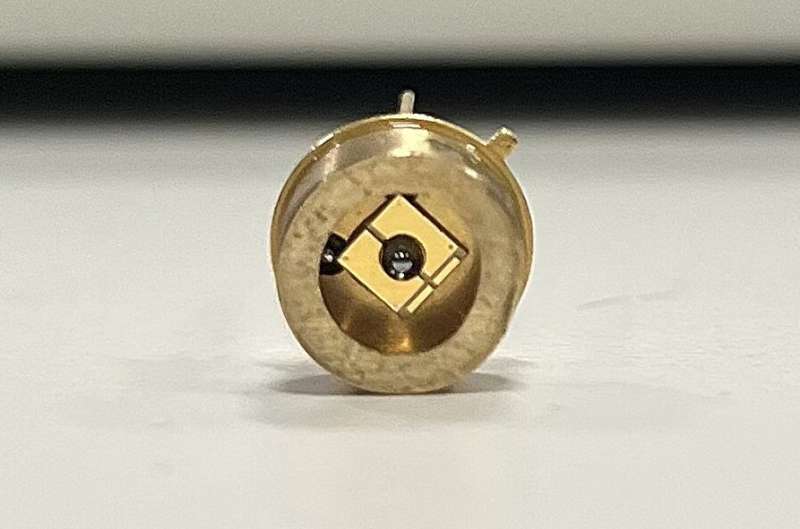
The approach relies on a semiconductor device called a thermoradiative diode, which rapidly switches between slightly brighter and slightly darker thermal emission states. These subtle variations encode digital information while remaining hidden within ambient thermal noise. Only a receiver designed to recognize the signal pattern can extract the transmitted data.
Because the transmission itself is effectively invisible, the method could add a new layer of protection to electronic communications. Unlike traditional systems where signals are detectable but encrypted, this technique makes the existence of the communication difficult to identify in the first place. Researchers say this property could prove valuable for sensitive communications in sectors such as defence, finance, and secure infrastructure.
Early laboratory demonstrations achieved data transfer rates of roughly 100 kilobytes per second. However, the team believes significant performance improvements are possible with advances in emitter materials and device engineering. Future versions could potentially reach gigabyte-per-second speeds, making the approach viable for practical communication systems.

The concept emerged from earlier work on thermoradiative devices used in “night-time solar” energy research, where similar semiconductor structures convert thermal radiation into electrical energy. By applying the same physics to communication systems, the researchers realized the devices could modulate infrared emissions in ways that mask signals within natural thermal backgrounds. Looking ahead, scientists are exploring alternative semiconductor materials and advanced structures such as graphene-based emitters to boost efficiency and transmission speed. If successfully scaled, the technology could introduce a new category of covert optical communication embedded directly within everyday thermal radiation.