By shaping resonators with smooth Euler curves, photons circulate longer inside the device, strengthening optical interactions used in sensing technologies.
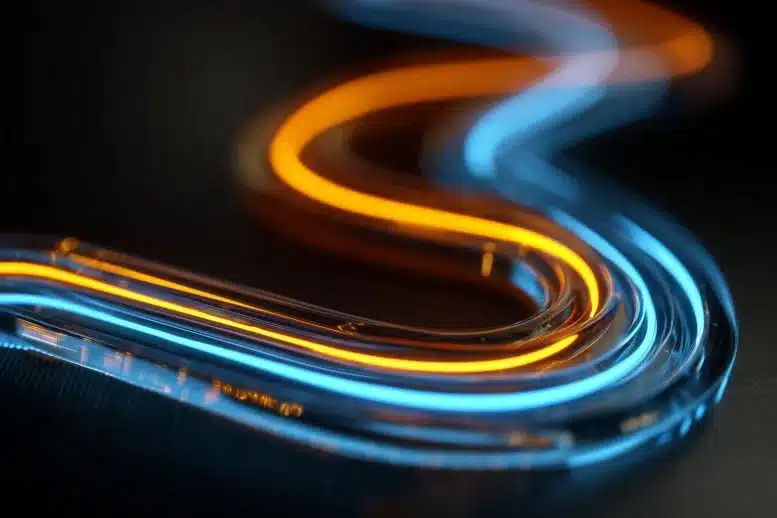
Researchers at the University of Colorado Boulder have developed optical micro-resonators that trap and amplify light with high efficiency. The benefit of these devices is their potential to power advanced sensors that operate with less optical energy, opening possibilities in navigation, chemical detection, and other precision applications.
The advantage of the team’s design lies in its racetrack-shaped resonators. By incorporating Euler curves, smooth bends commonly used in road and railway engineering, the researchers minimized bending loss and allowed photons to circulate longer inside the device. This extended interaction strengthens the optical effects needed for high-performance sensing.
At the feature level, the resonators were fabricated from chalcogenide glass, a material valued for transparency and nonlinear properties but difficult to process. Using electron beam lithography in a precision clean room, the team achieved sub-nanometer resolution, producing structures thinner than a human hair. Laser-based testing revealed sharp resonances, a sign of minimal light loss and strong efficiency.
The work combines geometry, material science, and fabrication techniques to achieve results comparable to state-of-the-art platforms. Chalcogenides enable intense light transmission with low loss, while the racetrack design ensures photons remain confined. Together, these advances create microresonators that could support a new generation of photonic devices.
Bright Lu, lead author of the research emphasising the broader impact, says “One day these microresonators can be adapted for a wide range of sensors from navigation to identifying chemicals.”