




Power systems are getting complex. This reference design shows a way to build multi-rail supplies with load support and protection features.
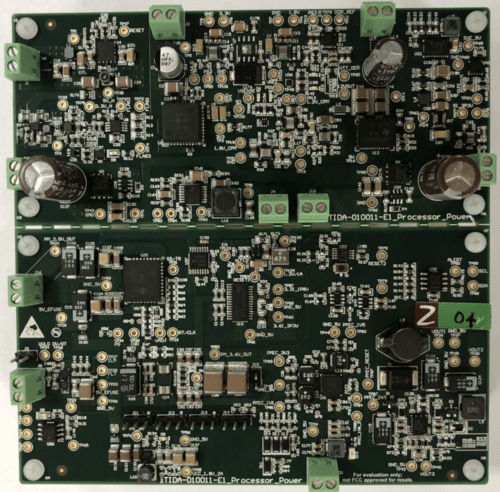
Power systems used in generation, transmission, and distribution often face failures that can lead to outages, revenue loss, and reduced generation capacity. To improve efficiency and reliability, utilities depend on secondary equipment for protection, control, monitoring, and measurement. TIDA-010011, a reference design from Texas Instruments (TI) addresses a key part of such systems by providing a way to generate multiple voltage rails required for processor-based modules, while maintaining high efficiency and supporting load currents above 1 A.
The design generates the required power supply from 5-, 12-, or 24-V DC input available from the backplane. It uses DC-DC converters with integrated FETs and a power module with an integrated inductor to reduce overall solution size. The design also targets applications where design time is limited by offering a tested and ready approach.
Several supporting features are included to ensure stable and reliable operation. These include voltage sequencing to manage power-up and power-down of multiple rails, a DDR termination regulator for memory interfaces, and input supply OR-ing for handling multiple input sources. Protection features such as an eFuse for overload conditions are also integrated. In addition, the design supports voltage and load current monitoring, which helps in diagnostics and system control.
Modern applications such as protection relays, digital signal processors, and field-programmable gate arrays require processors with multiple cores, high speed, standard Arm architecture, external DDR memory interfaces, and integrated peripherals. These processors perform signal and application processing tasks, including digital filtering, execution of protection algorithms, and handling of user interfaces such as LCD displays. They also support communication protocols like IEC 61850. Such requirements increase the need for multiple power rails, proper sequencing, voltage supervision, and stable DDR operation.
Load current in these systems varies depending on execution speed, application requirements, and operating modes. This leads to fast transient conditions and wide variations in power demand. Supporting multiple rails further increases the complexity of the power supply design and can impact overall system size.
Designing power systems for these applications involves challenges such as maintaining a small form factor, achieving high efficiency to reduce heat, and limiting electromagnetic emissions. There is also a need to protect against input faults, support redundancy and load sharing, and enable processor-level diagnostics such as voltage sequencing, monitoring, and current tracking. This reference design addresses these challenges and helps reduce design effort while enabling a compact and efficient implementation.
The design is suitable for use in protection relay systems, circuit breakers, and grid automation. In protection relays, faults are detected by monitoring electrical parameters that change under abnormal conditions. These systems interface with multiple inputs and outputs, including AC and DC analog signals, digital signals, and communication interfaces such as Ethernet, RS232, RS485, and USB. They also include human-machine interfaces like LCDs and LEDs, with processor modules handling algorithm execution and communication.
TI has tested this reference design. It comes with a bill of materials (BOM), schematics, assembly drawing, printed circuit board (PCB) layout, and more. The company’s website has additional data about the reference design. To read more about this reference design, click here.