What if one device replaced multiple protection components? An integrated contactor design simplifies EV systems while improving fault handling and reducing downtime.
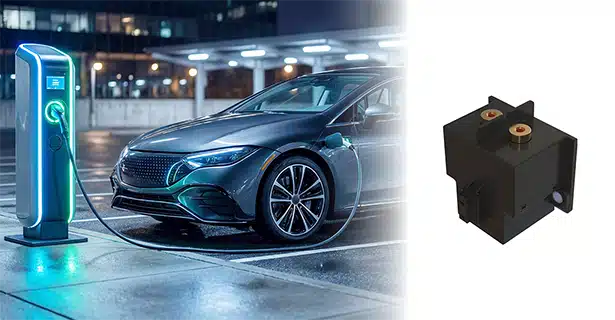
Sensata Technologies has introduced the FaultBreak contactor, a high-voltage switching and protection solution designed to improve fault management in electric vehicles while reducing system complexity. By combining fuse and contactor functions into a single device, the solution enables more compact and efficient EV power system designs.
As EV architectures move toward higher voltages and increased efficiency, managing high-magnitude fault currents remains a critical challenge. Conventional systems rely on multiple components, including fuses, contactors, and associated wiring, which add weight, cost, and design complexity. The FaultBreak contactor addresses this by integrating passive fault protection with switching capability, allowing it to interrupt fault currents without external detection electronics.
The device is validated to handle fault currents up to 16 kA at 1 kV, supporting protection against severe events such as battery short circuits. Its passive fuse functionality ensures consistent and rapid fault response, while an optional dual-contactor configuration can provide additional redundancy for applications requiring higher reliability.
A key advantage of the integrated approach is the reduction in component count by over 50 percent compared to traditional solutions. Eliminating elements such as pyrofuses and busbars simplifies system architecture, reduces thermal losses, and improves packaging flexibility. Unlike single-use fuses, the contactor can be reset after temporary faults, helping minimize downtime and maintenance costs.
The design also incorporates hermetic sealing to maintain low and stable contact resistance, supporting efficient power delivery over time. Its compact and lightweight construction aligns with the requirements of modern EV platforms focused on space and energy optimization.
“Our FaultBreak contactor represents an important advancement in high voltage protection,” says Markus Schwabe, EVP, Automotive, Sensata Technologies. “It helps enable safer, more reliable, and more cost-effective EV systems.”
Click here for the official announcement.