





Vector Photonics demonstrates PCSEL-based free-space optical communication outside lab conditions, proving reliable 500m data transmission and advancing secure, high-speed wireless connectivity for real-world applications.
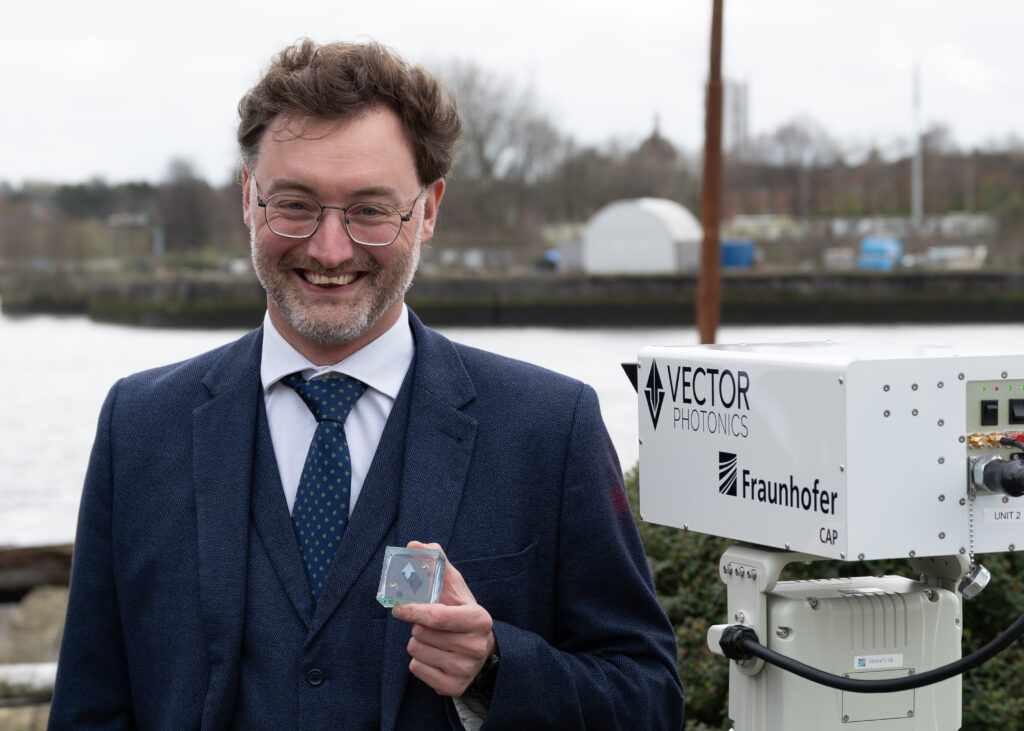
A Scottish start-up, Vector Photonics, has demonstrated free-space optical communication using a photonic crystal surface-emitting laser (PCSEL) outside laboratory conditions for the first time, signalling progress toward practical high-speed wireless data links.
Vector Photonics, in collaboration with Fraunhofer Centre for Applied Photonics, transmitted data across the River Clyde between the Glasgow Science Centre and the Clydeside Distillery, validating the technology in a real-world outdoor environment.
The system achieved data transfer rates of 50 Mbps over a 500-meter दूरी, maintaining error rates below forward error correction thresholds. The demonstration exceeded baseline system requirements and marked a shift from controlled lab testing to operational conditions involving environmental variables such as wind, humidity, and temperature.
PCSELs represent an emerging class of semiconductor lasers that combine the high output power of edge-emitting lasers with the speed and surface emission characteristics of vertical-cavity surface-emitting lasers. Their ability to produce narrow, high-brightness beams with low divergence makes them suitable for free-space optical links, where minimising signal loss is critical.
Unlike conventional laser sources, PCSELs deliver coherent single-mode output and efficient beam shaping without requiring complex optics. This simplifies system design while improving transmission efficiency over longer distances.
The demonstration advances PCSEL technology readiness toward deployment, highlighting its potential for secure, cable-free communication between buildings, campuses, and remote infrastructure. The approach also reduces reliance on radio frequency spectrum, offering advantages in bandwidth and security.
Beyond communications, the technology shows promise for applications in AI data centers, LiDAR systems, and additive manufacturing, owing to its wavelength flexibility across a broad spectrum.
The successful field trial underscores growing industry efforts to integrate advanced photonics into next-generation communication systems, positioning PCSELs as a viable alternative for high-speed, secure optical connectivity outside controlled environments. Richard Taylor said the demonstration marks a significant milestone, showing the company’s PCSEL technology is moving beyond research into commercially viable, real-world use. He noted that the trial represents the most advanced application of PCSELs to date, raising the technology’s readiness from mid-stage validation to near-deployment levels.
Testing the system in open-air conditions also confirmed its ability to operate reliably across environmental variables such as temperature shifts, humidity, rain, and wind turbulence, while maintaining performance over meaningful distances. Until now, PCSEL-based communication had largely been confined to controlled lab settings and simulations under ideal conditions.

