
A new low-profile inductor shrinks footprint without sacrificing efficiency, enabling compact power designs across industrial, consumer, and medical systems.
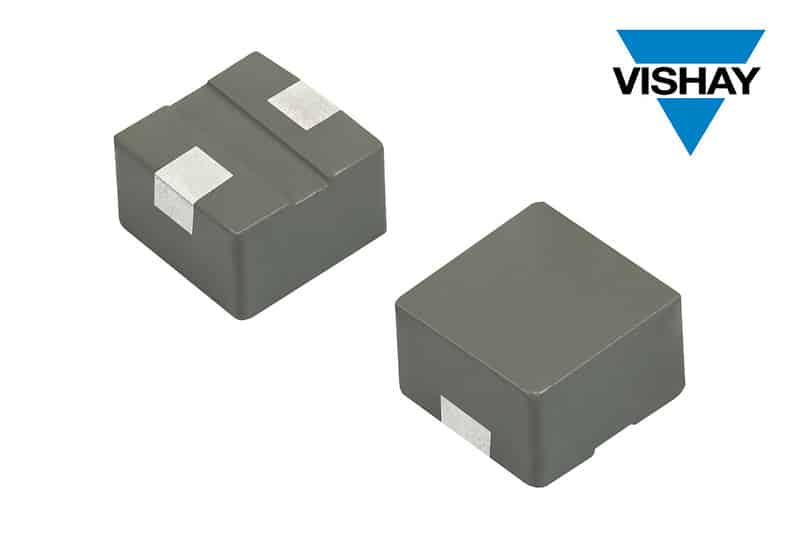
Designers working with tight board space now have a new option for high-current power stages, as a compact 1212-case inductor by Vishay Intertechnology, Inc., enters the market with performance typically associated with larger components. The device focuses on delivering strong current handling and efficiency in a 3.0 mm × 3.0 mm footprint, making it suitable for next-generation miniaturised electronics.
Built for DC/DC converter energy storage, filtering, and noise suppression, the inductor supports a wide range of commercial applications—from industrial tools and automation systems to consumer electronics, telecom infrastructure, and healthcare devices. Its flexibility is further enhanced by three height profiles—1.2 mm, 1.5 mm, and 2.0 mm—allowing engineers to optimise designs based on vertical space constraints.
The key features are:
- Compact 3.0 mm × 3.0 mm footprint with 1.2 mm to 2.0 mm height options
- Low DCR down to 8.6 mΩ for improved efficiency
- Rated current up to 14.3 A with high transient handling
- Inductance range from 0.22 µH to 3.3 µH
- Magnetically shielded powdered iron construction with low noise and high reliability
Efficiency remains a key highlight. The component achieves low DC resistance values starting at 8.6 mω, helping reduce power losses while supporting rated currents up to 14.3 A. It also maintains stable performance under demanding conditions, including high transient current spikes, without saturating.
A powdered iron core construction replaces traditional ferrite designs, improving magnetic stability and reducing performance variability. The fully encapsulated structure eliminates air gaps and provides inherent magnetic shielding, minimising interference with nearby components. This results in better reliability in dense PCB layouts.
The inductor is also designed for rugged environments and operates across a wide temperature range from -55 °C to +125 °C. Its composite, lead-free construction enhances resistance to thermal shock, moisture, and mechanical stress, while also reducing audible noise to very low levels.
With demand rising for compact, high-efficiency power solutions, this release reflects a broader shift toward smaller yet more capable passive components in modern electronic systems.
Click here for the original announcement.