What if pollution could power devices? A new system generates electricity directly from captured greenhouse gases without needing external energy input.

Sungkyunkwan University researchers have developed a gas battery that converts greenhouse gases into electricity during the capture process, introducing a new approach to simultaneous emissions reduction and energy generation.

Detailed in Energy & Environmental Science, the system, termed the Gas Capture and Electricity Generator (GCEG), is designed to generate electrical power directly from gas adsorption without requiring external energy input. Led by Ji-Soo Jang, the research team, in collaboration with Ajou University and Chungbuk National University, addresses a key limitation in conventional carbon capture, utilisation, and storage systems, which are typically energy intensive.
At the core of the system is an asymmetric architecture combining carbon based electrodes with hydrogel materials. When greenhouse gases such as carbon dioxide and nitrogen oxides interact with the device, they are adsorbed onto the electrode surface, triggering ion migration and charge redistribution within the system. These electrochemical processes generate a continuous flow of direct current electricity, effectively turning captured emissions into a usable energy source.
A key advantage of the technology lies in its ability to operate autonomously, eliminating the need for additional power inputs during gas capture. This not only reduces the overall energy cost of emissions management but also introduces a dual function system where pollutants serve as the input for energy generation. The approach enables simultaneous carbon mitigation and energy harvesting within a single platform.
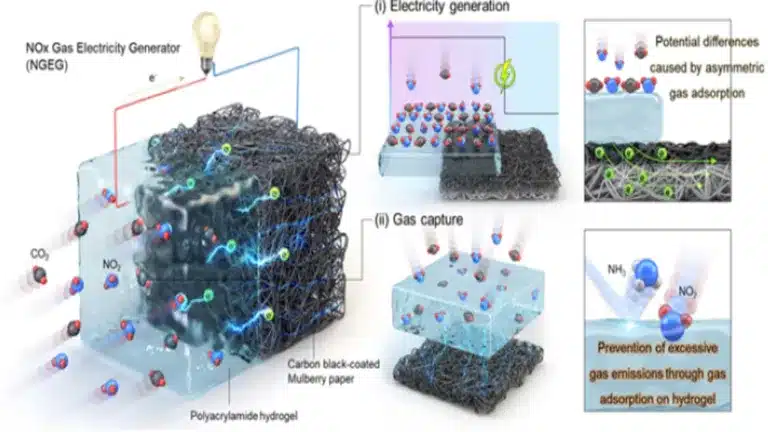
Beyond its core functionality, the system demonstrates potential for scalable and distributed applications. It could support self powered environmental sensors, battery free IoT devices, and industrial systems capable of recovering energy from exhaust streams. By integrating capture and generation, the technology also opens pathways for decentralised energy solutions in resource constrained environments.
The researchers highlight that the system reframes greenhouse gases as a potential energy resource rather than solely pollutants, with ongoing work focused on scaling and real world deployment.
“Capturing greenhouse gases while generating electricity offers a new paradigm for climate mitigation,” says Ji-Soo Jang, Assistant Professor at Sungkyunkwan University.