




Daily commuters in urban India are at a high risk of chronic health deterioration due to poor air quality. While those travelling in four-wheelers are safer to some extent, two-wheeler riders are at a risk of serious illnesses. Helmets are not sufficient to block out pollution, as these are neither equipped with filters nor have the capability to restrict bad quality air. Also, consistent helmet use often causes discomfort. Shellios Technolabs, a startup based out of New Delhi, identified this as a challenge that required immediate attention.
Amit Pathak, founder of Shellios Technolabs, came up with the idea for the solution in the winter of 2016, when Delhi’s air quality index rose close to 1000, causing mass concern. Pathak says, “There are a large number of citizens who travel by two-wheelers and are on the road almost throughout the day. There are no proper solutions other than clinical masks to save them. The masks are uncomfortable, irritate the skin and need to be changed often. These commuters face a high risk of catching impaired pulmonary function due to long-term exposure to pollution.” For a biker, the one thing that is mandatory while riding is the helmet.
Shellios team found a way to modify the helmet so that it could safeguard against pollution and injuries. Pathak decided to pursue this venture full-time, and Shellios Technolabs Pvt Ltd was incorporated in 2017. The design underwent multiple iterations before taking its final form, the Shellios Puros helmet.
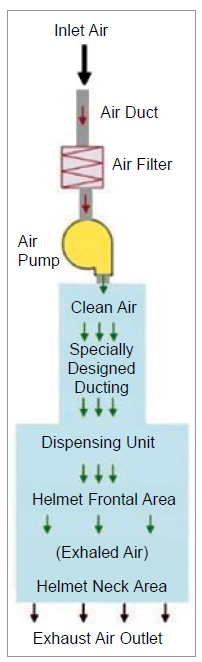
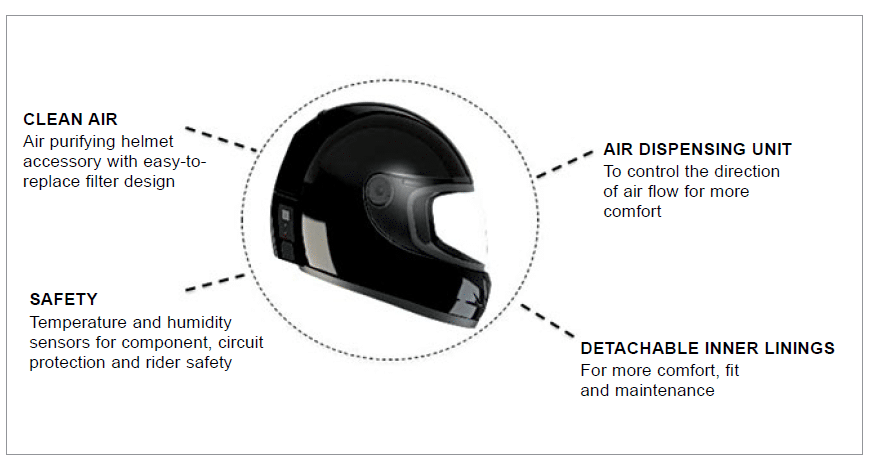
“Initially, we thought of integrating masks inside the helmet. But, that did not solve the inconvenience that the masks come with. Finally, we created a channel that purifies and delivers clean air in the breathing area inside the helmet,” Pathak explains. The working design Puros is essentially a helmet shell that includes a centrifugal fan powered by a lithium-ferro-phosphate battery and a specifically designed purification system. Interiors are covered with sponge for user comfort. Air ducts are designed to pass through the sponge (EPS) lining and brought near the face area, where purified air is dispensed via dispensing units. Air from outside is pulled in, purified and circulated via the ducts. The helmet shell is made of fibre-glass.
Filters in Puros are easily replaceable. The battery has 3300mAh capacity that can run for about four hours at peak speed on a single charge. The base helmet weighs 1.2 kilograms, while additional accessories add another 300 grams, summing up to about 1.5 kilograms for the whole unit.
The team is now working on a mobile application that will give real-time information on surrounding air quality, filter condition (a sensor reading clogging levels) and due replacement date, temperature and humidity. Regarding underlying electronic components, Pathak says, “We tried various microcontrollers (MCUs) and hardware to find optimal performance while keeping costs in check. Initially, we used ESP32, a powerful unit that supports Bluetooth, Wi-Fi and more. But it was power-hungry and became an overkill.
Moreover, it was expensive. Each IC would cost about US$ 4 – US$ Finally, we went ahead with MCUs from STMicroelectronics along with their own software toolkit.” Obstacles along the way Pathak says that the biggest challenge the team faced was getting the mechainical design right. Cost of prototyping was also high due to large component sizes. The prototype underwent four iterations of high-level designs before one was finalised. Scaling up to mass-production level was also not easy. He elaborates, “The whole process changes when you scale your product for commercial launch. You need to redesign the product keeping the scale in mind. This is called design for manufacturing (DFM).”
The units are being manufactured at a New Delhi-based factory. While the base helmet is being manufactured by one partner, electronic boards are being fabricated by another. Finding the right manufacturer was also difficult. He explains, “While prototyping, unit sizes and order volumes are small. Manufacturers have to spend more time and effort on lower production. It is hard to convince them to cooperate for an innovation because changing the setup every time for an innovation is not what they make money out of. They make money on manufacturing a large number of units of the same design or products at a go.”
The innovation process of the features was difficult, too. “Complexity unravels as you keep delving into production,” points out Pathak. A major strategy to reach out to the target audience is to work closely with the customers directly. Shellios participates in biker events where it showcases a Puros prototype and collects feedback.
Pathak says, “Our target segment includes citizens who own a 200cc or higher bike, who are willing to invest a reasonable price on a helmet for safety as well as comfort.” The price tag will be announced soon. Shellios will first roll out the helmets and later deploy the mobile application that is currently under development.
For quality assurance, the team is currently getting the product certified by Bureau of Indian Standards (BIS). Regarding marketing strategies, Pathak shares, “We will not be very media-heavy. However, we will be active with our customer interactions. We will participate in biker fests during winter months and get direct feedbacks. Digital marketing will also be an important operation.”
Shellios helmets will be distributed through online platforms like Flipkart, Amazon and automotive-specific sites. These will also be sold through offline channels via selected auto accessory stores.
Team Shellios has filed for a patent for Puros. It plans to strengthen its market presence steadily, taking one step at a time.



