The startup has developed portable, flexible EV fast-charging technology, removing dependence on fixed stations.
The climate technology startup, MCS Cargar Private Limited, was founded in 2019 by Raj Anupam and Kayavan Shah to address the challenge of electric vehicle charging infrastructure in India.
The startup has developed portable, flexible EV fast-charging technology, removing dependence on fixed stations. Its solution enables the deployment of charging infrastructure wherever required, rather than requiring users to visit dedicated locations.
The company builds portable fast-charging machines with power capacities ranging from 30kW to 180kW. These chargers can operate in multiple configurations, including on-grid, off-grid, solar-powered, and hybrid systems.
Raj explains that the company manufactures portable chargers designed for easy relocation. For instance, a charger used in a residential area during night-time can be moved to commercial or corporate locations during the day, if required.
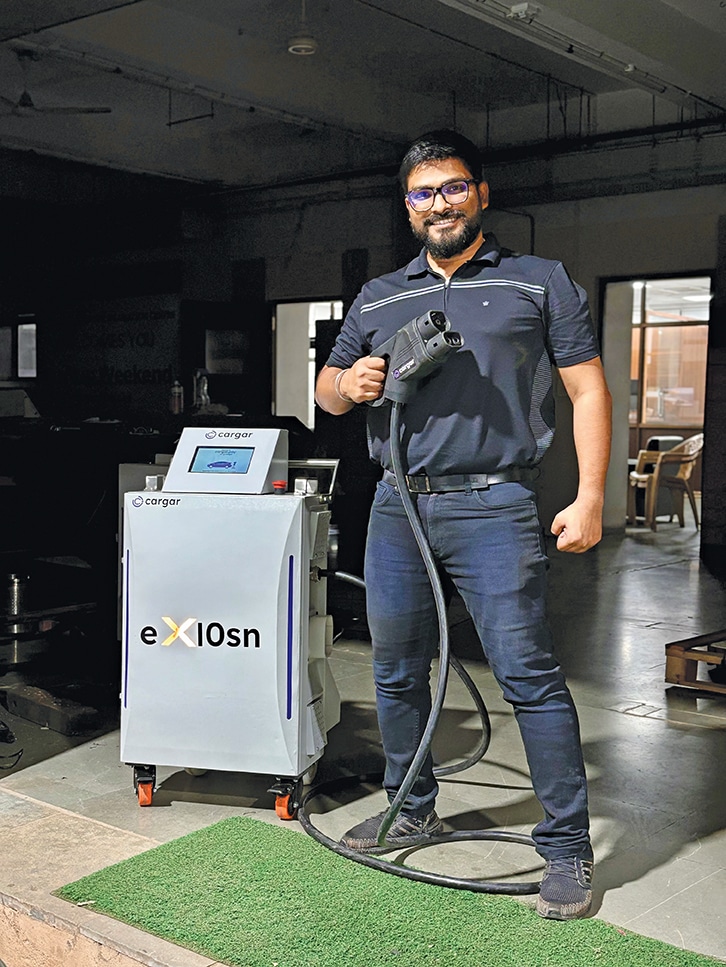
These chargers require three-phase electrical supply, which is readily available in almost all residential and commercial buildings. In most cases, installation involves connecting a submeter to the existing electrical panel. This eliminates the need for heavy civil work or major infrastructure upgrades, making deployment simpler and cost-effective.
The startup operates primarily as an original equipment manufacturer (OEM), designing and producing portable charging machines. Its customers include charge point operators, electric vehicle fleet operators, commercial real estate owners, corporate parking facilities, and public charging location operators.
The company has developed its own technology platform and communication system for the chargers. “Our system enables direct payment through the Unified Payments Interface (UPI). Drivers can scan and pay via UPI without downloading an app or maintaining a digital wallet. The charger communicates locally and continues operating even during temporary internet outages. Charging stops automatically once the prepaid amount is exhausted. Operators can also use the software platform to receive payments directly into their accounts,” Raj explains.
From a technology standpoint, the company holds several intellectual property assets, including a utility patent related to its charging platform and multiple design patents. The technology emphasises modularity and scalability, enabling the system to efficiently support a range of electric applications.
The startup claims its chargers are largely manufactured in India, with the platform positioned as a 100 per cent ‘Made in India’ technology solution. Approximately 70 per cent of the components are produced in-house, including control systems, software, and system integration. Some specialised components, such as charging guns and certain electronic chips, are sourced from Germany to ensure reliability. Research and development, testing, and algorithm development are conducted internally by the company’s engineering team.
The startup is headquartered in Ahmedabad and operates with a team of around 12-13 members. While some fabrication work is outsourced, the core technological development remains in-house.
Cargar began commercial sales of its chargers in August 2025, following several pilot deployments across the country. Since then, the company has sold around 30-40 units. Its chargers are currently deployed in regions such as Maharashtra, Delhi NCR, Bengaluru, and Gujarat. The starting price of the chargers is approximately ₹400,000, depending on configuration and capacity.
Like many technology startups, the company faced challenges, including product development hurdles, market readiness, and the need to align innovation with real-world demand. Persistence, strong belief in the technology, and continuous customer feedback helped refine the product and bring it to market.
Raj explains that the company name ‘Cargar’ is derived from the Spanish word that means ‘to charge’ and carries a Hindi connotation of efficiency and impact. The company’s long-term vision is to make charging accessible everywhere, enabling faster adoption of electric vehicles across India.
Looking ahead, Cargar plans to continue investing in technology development. The company is working on innovations like hybrid systems combining grid and alternative power sources, solar-integrated fast chargers to reduce emissions, and intelligent systems that analyse driving and charging patterns to optimise charger deployment.