





An optical wireless system that combines Li-Fi and quantum key distribution, potentially enabling fibre-free secure communications for industrial networks, critical infrastructure, and future mobile quantum applications.
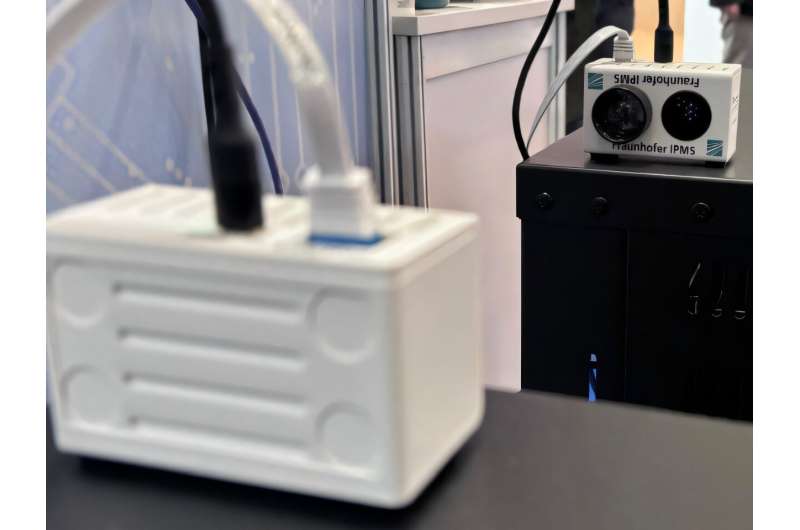
A German research consortium has demonstrated an optical wireless communication architecture that combines Li-Fi with quantum key distribution (QKD), marking a step toward secure wireless networks that operate without depending on fiber infrastructure or conventional radio systems. The development could enable deployment of quantum-secure communication in industrial facilities, transportation systems, and critical infrastructure environments.
The system, developed under the QuINSiDa project, integrates free-space optical communication with both Continuous Variable (CV) and Discrete Variable (DV) QKD technologies. Unlike conventional quantum communication systems that typically rely on dedicated optical fibers, the new approach uses a line-of-sight optical link to deliver encryption keys wirelessly while supporting secure data transmission.
The architecture also combines multiple operational layers including key management systems, encryption functions, and monitoring capabilities into a single framework. Researchers indicated that the demonstration shows operational readiness beyond isolated laboratory experiments, moving closer to practical deployments.
Li-Fi, or Light Fidelity, transmits data through light instead of radio frequencies. Because of its directional nature and lower susceptibility to electromagnetic interference, Li-Fi has gained attention for environments where RF communication may be restricted or where additional security is required. In the demonstrated system, Li-Fi not only carried classical data but also worked alongside quantum communication channels within the same optical infrastructure.
Potential applications extend across maritime operations, airport and aviation networks, industrial campuses, automotive systems, temporary secure installations, and fixed-to-mobile communication links. These use cases often require flexible deployment where laying dedicated fiber connections may be expensive or impractical.
The work also aligns with broader progress in free-space quantum communication. Previous demonstrations, including wireless QKD experiments by research organizations and space agencies, have shown the potential of transmitting quantum-secure information over open-air links.
While large-scale deployment will still need solutions for issues such as atmospheric disturbances, alignment accuracy, and range limitations, integrating Li-Fi and QKD into a unified wireless platform may provide a pathway toward future quantum-secure communication networks.
