




A new open foundation model aims to help robots, autonomous vehicles and industrial machines better understand, simulate and interact with real-world environments through advanced physical reasoning and world-generation capabilities.
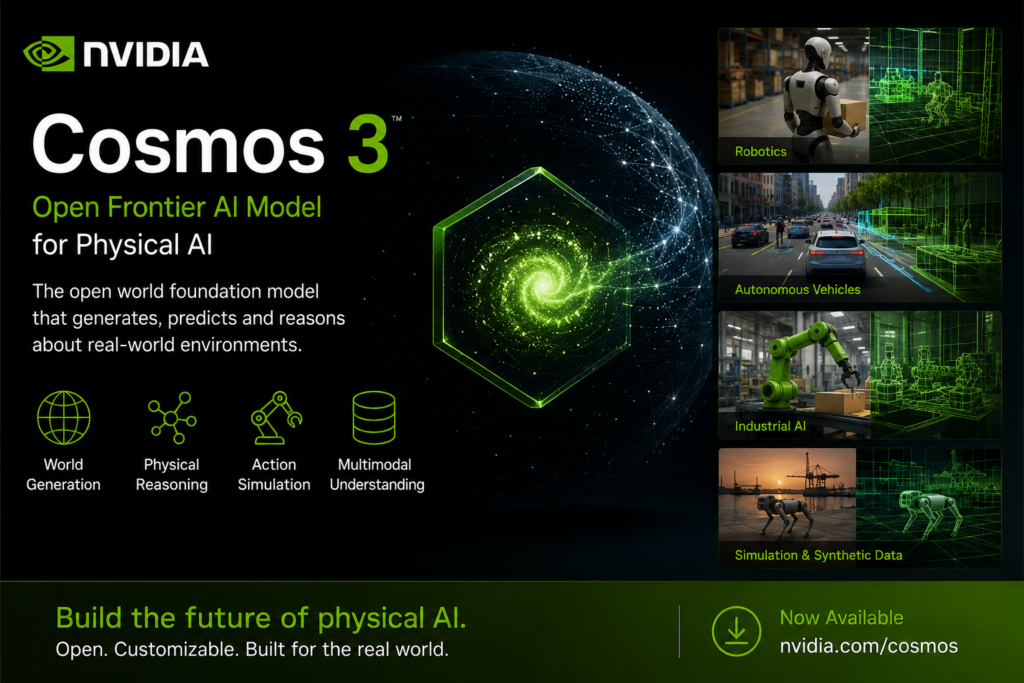
A major new foundation model for physical AI has been unveiled by NVIDIA, marking a significant step toward more capable robots, autonomous vehicles and intelligent industrial systems.The open model, called Cosmos 3, is designed to generate, predict and reason about real-world environments, helping AI systems understand how objects, people and machines interact in physical spaces. The release expands the growing category of world foundation models, which are increasingly viewed as a key technology for training AI beyond text and images.
The main features are:
- Open and customizable world foundation model architecture
- Combines world generation, reasoning and action simulation
- Trained on large-scale multimodal datasets including video and sensor data
- Supports robotics, autonomous vehicles and industrial AI applications
- Enables synthetic data generation and physics-aware environment simulation
Cosmos 3 combines synthetic world generation, physical reasoning and action simulation within a single framework. Developers can use it to create digital environments, test robotic behaviors and generate training data for autonomous systems operating in complex real-world conditions.
The platform is available under an open model approach, allowing researchers and enterprises to customize and fine-tune models for specific use cases such as warehouse automation, manufacturing, logistics and self-driving vehicles. The strategy reflects a broader industry shift toward open AI ecosystems that enable faster experimentation and deployment.
A key differentiator is the model’s ability to process and learn from large-scale multimodal datasets that include video, images, text, audio and action sequences. This allows AI systems to develop a stronger understanding of spatial relationships, motion, object permanence and cause-and-effect interactions in dynamic environments.
The launch comes as demand grows for AI systems capable of operating in the physical world rather than only digital applications. Industry players are increasingly investing in simulation technologies and synthetic data generation to reduce the cost and complexity of training robotics and autonomous platforms.
The new model is expected to support a range of physical AI applications, including humanoid robots, industrial automation, autonomous driving systems and next-generation simulation environments. By providing open access and customization capabilities, the platform aims to accelerate development cycles and lower barriers for organizations building embodied AI systems.
The release further highlights the industry’s push toward creating AI models that can reason about the real world, paving the way for more adaptive and autonomous machines.
Click here for the original announcement.


