

See how engineers can build, connect, test, and validate vehicle systems using one reference design.
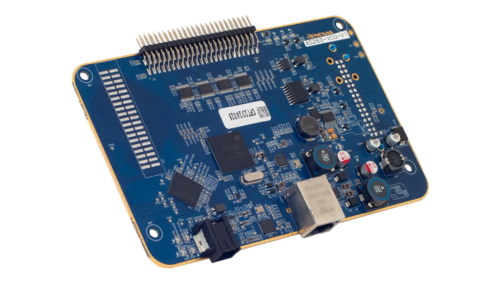
The AS260 Vehicle Control Unit (VCU) reference design from Renesas provides automotive design engineers with a ready-to-use platform for developing, testing, and validating vehicle control and communication systems. Instead of building a control unit from the ground up, engineers can use the reference design to evaluate hardware, software, connectivity, and network architectures before moving to production development.
One of the primary uses of the platform is the development of central vehicle controllers and gateways. Engineers can use the board to manage communication between multiple electronic control units (ECUs), sensors, and vehicle subsystems. This allows them to study how data moves across a vehicle network and evaluate the performance of centralized and zonal electronic architectures used in modern vehicles.
The reference design also enables engineers to test a wide range of automotive communication interfaces. With support for CAN, LIN, Ethernet, UART, SPI, I2C, PSI5, and RSENT, developers can connect sensors, actuators, and external control modules to evaluate data exchange, signal integrity, and system responsiveness. This makes the platform useful for integrating components commonly found in powertrain, body control, chassis, and safety systems.
For engineers working on sensor integration, the board provides an environment for connecting and validating different sensor types. They can develop software drivers, test sensor communication, monitor data flow, and verify system behavior under various operating conditions. The platform can also be used to evaluate how multiple sensors interact within a larger vehicle network.
The Gigabit Ethernet and 100 Mbps Ethernet interfaces allow engineers to develop and validate high-speed in-vehicle communication systems. These interfaces can be used to test zonal architectures, gateway functions, diagnostics, over-the-air software update mechanisms, and communication between central computing platforms and distributed vehicle nodes. As vehicle architectures continue to move toward software-defined models, these capabilities help engineers evaluate future-ready networking approaches.
The reference design can also be used for system-level testing and validation. Engineers can connect the VCU to battery management systems, control modules, and other automotive development boards to simulate real vehicle environments. This enables early verification of hardware and software interactions, reducing development risks before production implementation.
For connected vehicle applications, engineers can leverage the platform’s support for Bluetooth Low Energy, Wi-Fi, LTE, HTTP, and MQTT communication protocols. These capabilities allow developers to build and test telematics systems, remote monitoring applications, cloud-connected services, and vehicle data collection platforms. Engineers can evaluate how vehicle data is transmitted, processed, and shared with external systems.
The included sample software, programming tools, and debugging resources further accelerate development. Engineers can use these resources to create application software, test communication stacks, debug system behavior, and validate new features without starting from a blank design. This shortens development cycles and allows teams to focus on application-specific functionality rather than basic platform bring-up.
Renesas has tested this reference design. It comes with a bill of materials (BOM), schematics, assembly drawing, printed circuit board (PCB) layout, and more. The company’s website has additional data about the reference design. To read more about this reference design, click here.